

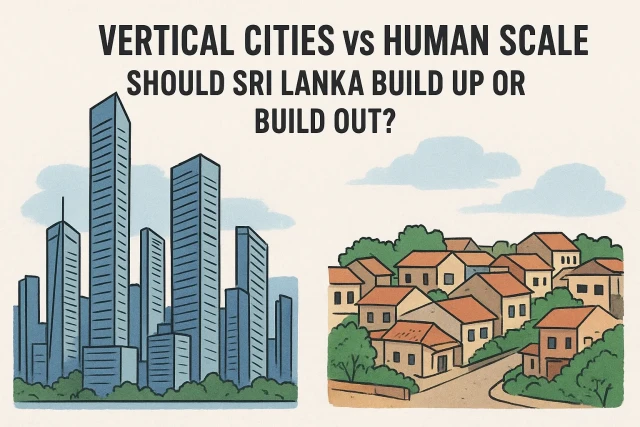
Vertical Cities vs Human Scale: Should Sri Lanka Build Up or Build Out?
The urbanization in Sri Lanka has reached a point of no return. As cities such as Colombo grow, the question is a pressing one, whether the city should focus on high rise developments and towers or whether the city should stick to low rise and human scale development. Both styles have their positive and negative sides and it is crucial to achieve a healthy balance between them so that cities could not only be efficient but also pleasant to live in.

One definite advantage that vertical cities can provide is density building and resulting density mitigation to the elements that surround them this allows the cities to house people using minimal space especially since the buildings are constructed horizontally. Cities can be built vertically as more people are housed in less space. This is especially considering in the urban areas where the land is very limited and the prices of properties are on increase. Tall buildings pave the way to clear more grounds to establish new parks, public spaces and infrastructure. Less sprawl is also achieved and the agricultural land and natural ecosystems around the city are preserved at the edges. On paper, this type of growth is sustainable urbanization
Understanding the Trade-Off: Density versus Livability
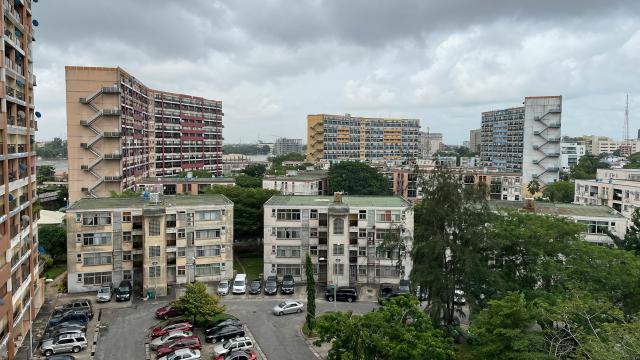
And density has its trade-offs. Living in high-rise can feel lonely and isolated especially to a family, the old and the children. It is the human habit to avoid such interaction, when humans are living very high above the ground. Vertical housing can be designed with more of an orientation toward functionality rather than community, a formula that results in sterile housing with no connection to the pulse of street life. Even streets and use of sidewalks are substituted with elevators and shared life may be replaced with anonymity. High-density housing projects are planned poorly; otherwise, they are the type of building residents live in, rather than in homes.
Conversely, human-scaled development will promote interaction, walkability, and social cohesion. Streetscape is based on low- to mid-rise buildings accommodating the ability of people to see, hear and interact with each other. Small courtyards and shared spaces at street level entrances make it comfortable to form connections and a feeling of belonging. Children, elderly and other people who flourish on day to day interaction can gain the advantage of this type of setting.
Nonetheless, horizontal construction as opposed to vertical takes up more space and demands infrastructure. Disputes over horizontal growth that require broad road networks, utilities and transportation. It makes people more dependent on cars, thus causing more congestion and pollution. The growth of cities takes them away to outlying areas, making it expensive to maintain and service distant neighbourhoods, whereas in most cases, municipal budgets cannot keep pace.
This is because the actual problem is how to balance efficiency and vertical growth with human services of low-rise development. Urban planners have to balance these against each other, to make cities not only dense to make it efficient, but also humane to make quality of life possible. One possible solution in the Sri Lankan situation, where fast urbanization is coming up head-on with deep-rooted cultural attachment to the soil and the community, is not necessarily to pick one of the two solutions, but to combine aspects of both.
The bottom line is that being tall or bad sprawling is not the only issue, but livable, sustainable and identifiable. Regardless of whether it is building up or building out, the aim is to make people live not to live - the spaces people live in should sustain life. It is the fate of cities in Sri Lanka that so largely depends on how successfully we will administer this precarious exchange.
Infrastructure Realities and Urban Resilience
Infrastructure forms the center of the debate when considering whether Sri Lanka should go vertically or horizontally. The high-rise necessitates an extremely complex infrastructure that includes water supply, sewage system, electricity, lifts, waste management and fire safety systems; all of which have to work perfectly in high-rise buildings. In comparison, horizontal expansion puts a strain on the currently deployed infrastructure, extending its span across long distances which in turn can be inefficient and requires high maintenance, even causing delays. The two models test resilience of a city in varying manners.
In order to make vertical development successfully, Cities must have unbroken and uniform services. Infrastructure failures are especially easy to exploit in high-rise buildings. The loss of power in a tall building is capable of shutting down elevators, water pumps and lighting to dozens of stories. Vertical density can become vertical disaster because of a poor waste system or poor fire system. Hence vertical growth needs solid management, frequent checks and trained services personnel, none of which can be compromised.
Cities like Colombo already face that problem of disruption of services periodically. These systems have to be upgraded and strengthened before they have been vertically expanded. Water pressure systems should be made to reach high levels. Electrical grids require redundancy and back-ups. The evacuation procedures of high-rise buildings must be prepared and the system to deal with large waste flows through dense populations must be established.
On the contrary, the expansion outwards appears more feasible in regards to the infrastructure requirements--at least in the short run. The maintenance and ease of serviceability of low-rise housing is increased. Systems of gravity-fed water distribution, ground based garbage collection are easier to create. It is possible to construct the roads on demand. Nonetheless, the horizontal growth imposes additional long term infrastructure burdens. The closer a neighborhood to the center of the city, the cheaper the costs to extend the utilities and services. It gets more auto-dependent flows and makes more pressure on streets along with getting traffic congested.
Besides, horizontal expansion contributes to the spread to the cities. The streets are broader and more roads, which means more to absorb heat surfaces and less green cover. It is also more difficult to establish sustainable systems of the urban transport due to the sprawl aspect as density is relatively low so that efficient routes can be established.
The resilience of urban areas should also be quantified by gauging the effect of cities on climate change. There are also increasing temperatures, flooding and extreme weather events which are putting infrastructure systems to the test. Flood prone regions are very dangerous with high-rises considering that unless they have fitted drainages and high elevations. At the same time, low-rise sprawl nibbles away at wetlands, natural buffers, raising flood risk in another aspect.
Resilience should be integrated in the planning both vertically and horizontally. The infrastructure should not be an afterthought; it should be front and center of the city development. In the case of Sri Lanka, this would not be the mere acquisition of new buildings, but systems as well to ensure that they work. Water lines, power grid and transport systems are the spine of our cities; they have to be prepared to accommodate them, whether they grow up or out.
Social Fabric and the Shape of Community Life
City planning has an enormous influence on the way the people live, communicate and socialize. That is where the vertical and horizontal cities controversy comes in particularly. The urban way of building a city has a direct impact on the social arena, on how people get to know their neighbors, the way children communicate during a play, how to accommodate the old local people, and how a society works day in day out.
Life in the community is more natural in the horizontal, human-scale, and environment. Natural meeting places are formed in front yards, porches, smaller streets, and local market. Occupants will be able to walk a lot more, say hello to each other, and connect more socially. Kids are able to play outdoors without going through any danger, and there is stronger mutuality and accountability. The neighborhoods in question tend to have a local identity, based on continuity in culture and history.
On the contrary, vertical living alters the pattern of community life. Human beings are closer together physically but in most cases socially as well. It may be a very common situation when people living in a high-rise building hardly know their neighbors. Extend corridors, security, and personal lift will make one feel alone as opposed to a collective. Children might have access sky-high or basement playground, but it is half of the ability to freely move around in the Neighbourhood Park or road.
Such broken social distance does not come with vertical living as such, it is a creation of tower designs and their management. It is possible to ensure that high-rises become communities when architects and planners focus on community spaces, communal facilities, and universal design. A connection can be cultivated by rooftop gardens, common rooms, shared kitchen, and co-living spaces. However these features are very expensive and will need to be planned and they are usually absent in the budget-type vertical development.
The older people, also, have distinct peculiarities of the high-rise housing. Seniors may feel lonely and disconnected when they do not interact on a regular basis. In foot-powered ground-level communities, the elderly characteristically stay active longer, leading a semi-independent lifestyle going to nearby stores, talking to neighbors, enjoying local festivals and activities. Small-scale dwelling proves to be so much more accommodating to aging-in-place than cold high-structures.
The use and sharing of space is also determined by cultural values. Generally, Sri Lanka families are multigenerational and family relationships with neighbors are very close. Unless designed to suit big families, in-laws and usual visitors vertical living may impair these relations. Horizontal design, in turn, is more conducive to long-term family dwellings and the rites of everyday life related to religion, food, and society.
The life of a city is social. People suffer, no matter how modern or efficient the infrastructure turns out to be- when the community feels fragmented or impersonal, something has gone wrong. The urban development of Sri Lanka should not only think of the number of people that can be accommodated in a space, but it should think of how people will live in that space, interact with each other and how to flourish in the area. The most prosperous ones are cities, which do not waste human interaction; cities where you can create long boulevards, or embrace the surroundings, and there are common balconies.
Environmental Impact: Vertical Efficiency vs Horizontal Expansion
One of the most decisive factors that must be considered in the case of Sri Lanka to design its urban strategy in the future is the ecological effects of building up versus mean building out. Vertical and horizontal growth models produce certain environmental effects which are unique and they are the understanding of these effects which hold the key to producing a city that will not only be functional, but will also be environmental friendly.
Vertical growth is in a way, presented as the more environmentally friendly alternative since land is utilised much more efficiently. When grouped properly, high-rises allow to keep open spaces and minimize the necessity to invade the farmland, wetlands, forests, and other sensitive places. Vertical cities also fight the battle of habitat loss and environmental degradation by concentrating the population in such smaller footprints that combat urban sprawl one of the leading contributors of habitat loss and environmental degradation.
Another possible advantage is energy efficiency. High-rise buildings with shared walls and shared systems can be built in a way that reduces energy and resource distribution in comparison to the loose network of single-family homes. An example of this is that collecting heat, air-conditioning, drinking water and collecting garbage is usually simpler to do in one building than in hundreds of individual units. Vertical buildings are able to carry enormous weight of materials and are not only self-supported, but can also greatly minimise the carbon footprint of a city as long as built with renewable energy, passive ventilation, green rooftops, and sustainable building materials.
However, on ground terms are different. Badly formulated high-rises might utilize more energy compared to the energy saved. Lifts, general lighting systems, pressurized water distribution and air conditioning play a significant role in business expenditure and the amount of emissions released into the atmosphere particularly when buildings are not constructed based on being green. In addition, building tall structures especially those that incorporate cement, steel and glass can be quite expensive to the environment in comparison to low rise buildings.
Although horizontally developed aesthetic may appear more natural, it can be much more harmful to nature, unless well thought out. The urbanization process uses land around the cities thereby pushing cities out thus using land that may belong to the forest, paddy fields, coastline areas etc. It divides up ecosystems, raises seepage on the surface and interferes with local diversity. The development of roads and houses on the territory of the green big picture creates heat islands and interrupts natural water cycles.
Car dependency is also even trapped in urban sprawl. Houses are more spaciously situated and streets that are supplied with medications are more inconvenient, which makes the residents more dependent on their vehicles and contributes to greater pollution to the environment and carbon dioxide emissions. Traffic congestion does not simply make life worse, but it is a cause of grave environmental and health issues in over populated nations such as Sri Lanka.
Conclusion
The country of Sri Lanka now faces the threshold of its urbanization. The vertical building vs. horizontal building argument is not an architectural or a skyscraper esthetical one, but is it a question of identity, sustainability, quality of life and long-term resilience. With buildings filling the urban centers and overwhelming our infrastructure and the natural environment, the population is pushing against the city and the way we make our cities.
Vertical cities are thus an efficient use of land, possibility of environmental benefits and the lure of the modern. However, absent careful planning and solid infrastructure, they may turn out to be vertical ghettos, cutoff, resource-dependent and sterile in terms of community living. On the other hand, horizontal expansion is much more in line with cultural values and creates stronger social ties. Un moderated sprawl however consumes nature, jams up roads, and zaps up government resources.
It is not one or the other but an intelligent combination of the two. Sri Lanka has to come up with a hybrid model of adapting vertical solutions in those areas where it is needed due to density and horizontal solutions in areas that allowed by the land and the community. The movement should be a dynamic, human-oriented planning, encompassing culture, climate, infrastructure and environmental stewardship.
The policy makers, architects, and, communities should work collectively in a way that development choices are made, not only in pursuit of structural economic welfare, but, also of human and ecological wellbeing in the long run. There can be no making or doing-without in cities, no matter where we build up or build out: our cities must be places in which people can live, with pride, belonging, and hope.
Eventually the success of the cities in Sri Lanka will not be estimated by the height of its buildings or the distance that it has scattered the suburbs but it will be by how well the cities can sustain the lives that are being lived there.
Also Read: “Why Sri Lanka Needs to Combine Land Reforms and Welfare to Solve Its Housing Deficit”



-3dkuLgKhRD.jpg)
-49HupTvwDD.jpg)








LEAVE A REPLY