

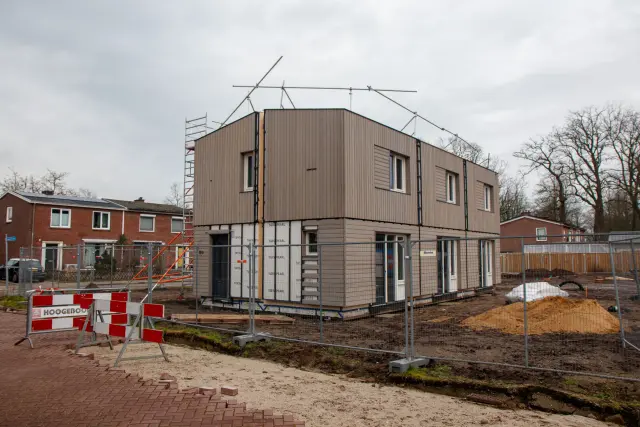
Prefabricated Housing in Ghana: How Cost-Effective Building Methods Are Changing the Market
The housing industry has been experiencing a lot of problems for many years, and the demand for affordable housing has been rising continuously and exceeding the supply. A significant housing shortage has been experienced in the country due to rapid urbanization, population increase, increasing costs of construction, and complicated land acquisition procedures.
 The strain on urban housing systems is on the rise as increasing numbers of
people continue to migrate to the cities in search of economic opportunities and better living conditions in urban centers like Accra, Kumasi, Tamale, and
Sekondi-Takoradi.
The strain on urban housing systems is on the rise as increasing numbers of
people continue to migrate to the cities in search of economic opportunities and better living conditions in urban centers like Accra, Kumasi, Tamale, and
Sekondi-Takoradi.
Finding affordable housing with comfortable standards of
construction is not as easy as it is supposed to be, and this is why many
households are forced to live in overpopulated homes, with the consequences of
the spread of informal settlements.
The conventional way of building in Ghana is usually based on the use of brick, cement block, sand Crete block, and on-site building procedures that consume a lot of labor, time, and material.
Although these techniques have been repeatedly employed over several decades, they tend to have lengthy construction periods and are expensive and therefore do not best suit massive housing shortages.
Also, the escalating prices of construction
materials and skilled labor have made housing more expensive hence many of the
low and middle-income families cannot afford to own a house.
To address these obstacles, new building technologies are presently being considered in the housing industry in Ghana. Prefabricated housing, or prefab housing, is one of the most promising methods.
Prefabricated construction entails the production of parts of buildings in a regulated factory setting and the facility is then conveyed to the construction area to be assembled. This process greatly shortens the time of construction, lowers cost and enhances quality control as opposed to the conventional means of building.
Prefabricated housing is now a trend all over the world
because it is efficient, sustainable, as well as flexible. The shortage of
houses in countries has led to the use of prefab methods of construction as a
way of constructing houses faster and cheaper, yet to high standards. These
systems contain modular houses, panelized structures, and prefabricated
structures of buildings that can be quickly assembled on-site.
Prefabricated housing technologies that have been introduced
in Ghana can change the nature of the housing market in Ghana by making homes
much cheaper and affordable. Prefab methods can contribute to ensuring a
reduction in the time and costs of construction, produce housing units faster,
which will help address the gap between the demand and supply of housing.
Moreover, the technologies may be used to pursue sustainable building
principles through minimizing the amount of wasted materials and enhancing energy
efficiency.
This blog discusses the increasing place of prefabricated
houses in Ghana and how affordable construction processes are transforming the
housing industry. It explores the housing problems of the nation, the
prefabrication concept, the economic and environmental advantages of prefab
construction, and the government policies that must be implemented to
facilitate its extensive use. With new avenues for the role of prefabricated
housing in addressing the housing shortage and sustainable urban development, Ghana can embark
on a new route of addressing the issue.
Ghana’s Housing
Deficit and the Need for Innovative Solutions
The housing shortage in Ghana has taken the status of one of the most urgent issues in the urban development of the country. It is estimated that the country has a shortage of millions of units in housing and the difference between these numbers keeps rising on an annual basis with the rise in population and urbanization in the country.
To solve this deficit, there is
need to not only create more housing units but to make these homes affordable
and within the affordable means of a large number of income earners.
The rapid urbanization is one of the main causes of the housing shortage. In recent decades, Ghana has witnessed a lot of rural-to-urban migration because individuals relocate to urban areas in pursuit of jobs and better living conditions.
Accra and Kumasi are examples of urban
centers that have grown extremely fast, yet housing construction has not
kept up with the population growth. The imbalance of supply and demand has led
to an increase in property prices and impacted the rental markets.
Another significant cause of housing deficit is high
construction cost. Research has shown that in most cases, construction of a
house through the traditional mode of construction costs a lot of money because
of the continued increase in price of cement, steel and other construction
materials. Quite a number of these materials are imported so their prices are
sensitive to the international markets and international currencies.
Besides the material cost, labor costs may be high as well.
Conventional construction practices have several phases of processes such as
site preparation, foundation projects, laying of the blocks, roofing,
plastering and finishing. Likewise, every one of these phases presupposes
professional work and may require many months or even years to be completed.
The housing development is also complicated by the land
acquisition process in Ghana. The ownership systems of the land may be a mess
which may be associated with traditional authorities, individual landowners as
well as government officials. When going through these systems, it may be
expensive and time-consuming, which puts potential developers off and slows
down projects in housing.
Housing finance is also another obstacle to many Ghanaian
households. Mortgage systems are not yet mature and the interest rates tend to
be quite high. Companies which are banking institutions usually demand regular
revenue and official records of employment prior to giving out housing loans.
This causes most informal workers not to be able to get a mortgage financing.
Due to these difficulties, a number of people and families
end up constructing houses slowly throughout the years or staying in a rented
apartment with excessive advance payments. The rest of them relocate into
informal settlements where they might find cheaper housing, but the
infrastructure and services are low.
Predominating construction technologies like prefabricated houses are some of the solutions to these problems. Prefab systems can dramatically cut the costs of buildings and give rise to delivery of housing units faster by cutting down on the time and wastage of materials used in construction. Such efficiencies would enable Ghana to deal with its housing shortage in a better way as well as enhancing the quality and sustainability of new housing constructions.
Understanding Prefabricated Housing and Construction Methods
Prefabricated housing can be defined as a mode of construction whereby the building parts are produced inside a factory or under controlled environment and then the parts are transported to the construction site where they are assembled together.
Contrary to the traditional building
where the majority of building processes occur in the building site location,
in prefab construction, a lot of the work is transferred to off-premises. This
method enables more efficiency, accuracy and quality control.
Prefabricated construction systems are also used in the
development of housing in a number of types. Modular construction is one of the
most widespread forms. In this system, complete parts or areas of a building
are fabricated in a factory and then delivered to the building site where they
are joined to make the ultimate structure. These modules could have complete
rooms that are already fitted by electrical wiring, plumbing and interior
fittings.
Panelized construction is another widespread way of
prefabrication. In this method, the construction of the panels like walls,
floors and roof sections are made in factories and assembled on-site. Such
panels may be constructed using different materials that may be steel frames,
concrete panels or insulated composite materials.
Prefab construction is also represented by pre-engineered
building systems. These systems use standardized components designed to be fitted together quickly and efficiently. Components are built to exact specifications; therefore, construction errors and material waste are reduced.
Speed is one of the advantages of prefabricated
construction. Since the manufacture of building components is done alongside
work at the site preparation, general construction schedules are greatly
minimized. Prefab systems often can be used to complete in a fraction of the
time the projects that would otherwise take several months or years with
traditional methods.
Another significant advantage is quality control. The
factory settings give the opportunity to supervise strictly and the production
process can be standardized, so that the building parts are developed under the
same quality requirements. This may lead to more robust and sound structures
than some of the traditional methods of construction.
Prefabricated houses have more design flexibility as well.
The current prefabrication systems offer various forms of architecture and
design, and hence can be used in a city as well as a country-style house
project.
Prefabricated housing technologies in Ghana are in an
initial implementation phase, although the technology has already been
investigated by a number of developers and construction firms as a means of
providing affordable housing more effectively. Prefab construction may gain
more and more significance in the housing industry of the country as awareness
and acceptance increases.
Cost Efficiency and Economic Benefits of Prefabricated Housing
The fact that prefabricated housing will help in lowering
the construction cost is one of the most interesting reasons why it should be
adopted in Ghana. Conventional construction processes are usually characterized
by high costs in terms of materials, construction, labor and long construction
periods. Another method of reducing such costs is to use prefabricated
construction which is more efficient.
The prefab components are manufactured through standardized
methods, which implies that the utilization of materials can be optimized and
the amount of waste can be greatly minimized. Smooth production processes
enable constructors to cut materials and eliminate unnecessary wastage that is
normally experienced in the construction site.
Prefabricated construction can also be in a position to
reduce labor costs. Most tasks which would have been performed by skilled
workers on the ground are done in a controlled setting in the factories with
specialized equipment. This will decrease the size of on-site labor forces and
minimize the general labor costs.
Less time to develop construction is also equivalent to
savings. Projects done in a shorter time make developers save in costs
associated with equipment rental, maintaining the project site and financing.
The quicker construction also enables the housing units to be available in the
market earlier to enhance the developers in terms of higher returns on
investments.
Large scale housing projects can also be supported using
prefab construction. Since the components are also able to be produced in large
numbers, developers can make multiple units of houses at a time, which also has
the benefit of economies of scale. This is especially the case with
prefabricated housing as it is very appropriate in government housing schemes
and in huge residential constructions.
In the case of the homeowner, prefabricated housing costs
can make the homeownership affordable. Reduced cost of construction implies
that housing can be sold at a lower price hence more individuals will have
access to quality housing.
Also, the prefab housing projects will provide new economic
opportunities to the construction sector. The manufacturing plants that are
engaged in the production of prefab components have the potential to create
workplaces in engineering, manufacturing, logistics, and installation services.
Prefabricated housing can transform the housing market in Ghana because it will
become more affordable and sustainable by enhancing efficiency and reducing costs.
Environmental Sustainability and Modern Construction Practices
Prefabricated housing is more than cost-effective because it
is also sustainable to the environment. Due to the increasing concerns related
to the climate change and degradation of the environment, the issue of
sustainable construction practices is gaining more significance in the
international building industry.
Prefabricated construction has resulted in one of the key
environmental advantages in terms of saving the waste of materials. The
production that is centred in factories enables the builders to make use of
material more effectively so that there is little wastage of material, which
would otherwise be wasted in landfills.
Another beneficial factor is energy efficiency. A large
number of prefab housing systems also use isolation materials and energy saving
architecture that enable to control the temperatures inside the buildings and
to conserve energy. This may result in a low cost of electricity among the
house owners and environmental impact is reduced.
The prefab construction also minimizes the environmental
impact that is caused by conventional building techniques. In that the greater
part of the construction processes is done off-site less noise, dust, and waste
is generated on the building site.
Another factor is the efficiency of transportation. Even
though the prefab elements have to be shipped between the factories and the
construction sites, the total transportation effect may be reduced compared to
the traditional building techniques that may result in several deliveries of
the materials over long distances.
Moreover, most prefab systems have been made in a way that they can support renewable power sources like solar panels, as well as rainwater collection systems. Such aspects can also increase the sustainability of housing developments.
Prefabricated housing is an opportunity to incorporate
sustainability into the construction industry, as Ghana is interested in
enhancing the country towards environmentally friendly development.
Challenges and Future Prospects of Prefabricated Housing in Ghana
Prefabricated housing continues to experience a number of
challenges in Ghana despite its numerous benefits. Public perception is one of
the greatest obstacles. Most individuals relate prefab housing to portable
houses or poorly constructed houses and yet, the current prefab technologies
are long-lasting and highly engineered.
Another problem is the limited awareness. The use of
prefabricated construction is quite new in Ghana, and hence most of the
developers, architects, and consumers are not conversant with its advantages
and use.
Regulations can also be required to be changed to be in line
with new building technologies. Standards and building regulations should also
be such that prefab housing does not violate safety and quality standards, but
can also facilitate building techniques.
Nonetheless, prefabricated housing in Ghana has got a
bright future. Prefab systems have the potential to play a significant role in
the housing strategy in the country as the need to construct affordable housing
and focus on new building methods emerges. Government aid, population
education, and investment in the manufacturing infrastructure will be effective
factors in enhancing the adoption of prefabricated housing technologies.
Conclusion
The problem of housing shortage in Ghana is a complicated
matter that needs new and efficient approaches. Conventional building
techniques might not be able to sustain the increased demand of affordable
housing in fast-growing cities.
Prefabricated housing presents it as a good choice due to
its short construction time, cost reduction, quality control and environmental
sustainability. These advantages are what have made prefab construction a
viable alternative for developers, policymakers and homeowners who want to
have a viable solution to their housing problems.
Although there are barriers like the perception of the
people and the regulatory restrictions that should be overcome, these barriers
can be overcome with increased awareness and favorable policies.
Ghana is still in the process of urbanization and the introduction of modern construction technologies like prefabricated housing might be significant in changing the housing market and enabling more citizens to own safe, cheap and affordable houses that would be sustainable.
Also read: Using Prefabricated Housing for Affordable Development in Nigeria













LEAVE A REPLY