

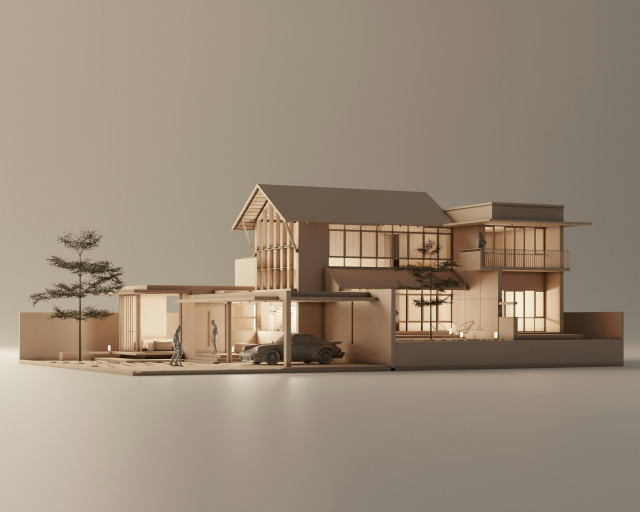
Passive House Design: A Sustainable Approach to Affordable Housing
The world is in a housing crisis and it has realized two needs of prime urgency; affordability and sustainability. Millions of households cannot afford living in a house that is reasonably comfortable, and societies and governments are also trying to cope with the rising impacts of the climate crisis. Energy-exhaustive construction processes and under-insulated buildings have always posed a two-fold challenge; not only have the prices of houses gone up but the carbon footprint has been continually rising. It is in this background where Passive House design is an effective and viable solution. The design originated in Europe, and is aimed at making best use of energy, minimizing long-term cost-effectiveness, and providing healthier, more comfortable interior environment.
Although remaining innovative, the tenets of Passive House are fast becoming a standard, particularly in regard to housing affordability as designers and planners realize the avenue they offer in meeting the needs of many people without compromise to the environment. This blog thoroughly discusses the Passive House design and how it can be relevant, limiting, effective, and full of potential in becoming a sustainable method of affordable construction going forward.
Passive House Principles and Their Relevance to Affordability
In its essence, Passive House design is founded on a set of clear yet highly productive concepts that help a construction severely cut down its energy use. These are extreme insulation levels, airtight construction, technologies on the windows and doors, and ventilation systems with heat recovery together with care on the thermo-bride free design. Unlike normal buildings, which may drop considerable amounts of heating through cracks, gaps, and inefficient heating and cooling systems, Passive House buildings do not really need much energy to sustain an indoor temperature throughout the year.
This is a vital innovation when it comes to affordability. A household that inhabits a new Passive House can save so much money on their utility bills, most often to the extent of 80-90 percent over the costs of traditional housing.
The energy bill on a monthly basis can be as heavy as rent or mortgage to low income households, especially in areas having severe climates. By focusing on operational costs, Passive House design points a good deal of financial pressure directly towards financial relief. The costs that appear to be marginally increased at the construction stage turn into a long-term asset to residents.
Notably, affordability in housing is not only about reducing the rent or the price of purchase; it is about making sure a home is affordable to maintain and live in over many decades, protecting it against variations in energy prices, and creating financial security. Passive House this extends affordability throughout a lifetime, protecting a family against changes in energy prices and providing it with far more financial security.
Along with savings on household expenditure, Passive House design goes further in enriching resilience. Extreme temperature spirals or temperature snaps are also rampant owing to climate change. During these times, they tend to exhaust conventional housing and thus, families have to depend largely on air conditioning or heating systems which are costly to both the households and the energy systems.
Passive House houses by comparison are comfortable with little need of outside energy source. This resilience helps both to cushion the families against climate crisis, but also during times of emergency affecting the community at large. When energy-efficiency goes hand in hand with affordability, Passive House can take its place as a groundbreaking paradigm of housing that solves current monetary burdens as well as sustainable concerns in the long run.

Overcoming the Barriers to Implementation
Although the advantages of Passive House design are hard to ignore, there are some obstacles that inhibit its rapid dissemination, especially within affordable housing. The most frequently replicated obstacle is unfavorable upfront construction cost. Increased initial cost in achieving the airtightness, adopting high-quality insulation, use of advanced windows and ventilation systems are other drawbacks that people face through conventional building methods.
More expenses are an intimidating possibility to developers who have to work with minimal margins on affordable housing developments in the first place. When considered in the long-term perspective, the building life cycle, however, the returns on investments become obvious. Substantial savings through lower initial and operating cost, less maintenance, and longer life of the building, more than compensate, the initial spending cost. It is, thus, the challenge to change the financial models that are employed by the developers and policymakers to consider future affordability rather than the initial costs.
The other obstacle is the absence of the extensive experience in Passive House construction. A builder and contractors who are quite used to conventional building methods might not have that kind of specialized training that can be used to construct airtight and energy efficient designs. This gap in skills may lead to increased salaries and issues of poor quality. This can be rectified by investing in the education of the labor force and up building local competencies. The more professionals gain experience the more costs are likely to be reduced and thus Passive House can be used in affordable housing projects.
Regulatory frameworks may as well inhibit as a barrier. Because the Passive House standards are not completely integrated into, or known by, building codes in many jurisdictions, developers are uncertain about how to meet standards or they miss out using incentives. The government can also play a significant role in ensuring that there is smooth flow of regulations, providing tax credits, subsidies or zoning bonuses in order to stimulate the development of energy-efficient housing. Absent such encouraging policies, the affordability advantages of Passive House can continue to be inaccessible to those communities in the greatest need.
Cultural perceptions also dispute difficulties Passive House is commonly thought of as a high-end approach to making environmentally aware elites but in reality, it is a more affordable sustainability option that can be applied to everyday families. Reducing this perception would involve education and demonstration types of building which focus on how Passive House design can enhance the quality of life at an affordable price. By demystifying PB and illustrating how affordable PB developments have worked in practice, stakeholders will be able to develop a base of public and political support to bring PB to scale on a larger scale.
Passive House and Healthier Living Environments
Environmental and economic advantage are not the only amenities of the Passive House design. Health benefits of the buildings can be as well praised as important. The problems which are common in traditional low-income houses include mold, drafts, bad ventilation and soaring temperatures. Not only would living become uncomfortable under these conditions but they also would become susceptible to long-term health problems, such as asthma, allergies, among other respiratory conditions. Passive House design gives these issues by fighting fire with fire: advanced ventilation systems, airtight building.
Passive House design is characterised by the incorporation of mechanical ventilation equipment with heat recovery (MVHR). This system constantly circulates clean pushed air as well as reclaiming heat in the tired air left behind so its residents breathe in clean, pollutant free air without losing any heat. Indoors the filtration level of this product ensures that the pathogen advancement or pollution of the air is minimal with families in these urban areas getting a better air quality to breathe. Moreover, the resulting constant indoor temperatures that are enabled by airtightness and insulation high levels eliminate drafts and cold spots to create a more comfortable and stable living environment.
And the healthier homes imply healthcare efforts directly saved by residents and the subsequent load on the public health care system. In vulnerable groups of people (children, the elderly, or individuals with preexisting health conditions), the impacts of a continuous, stable, clean, and comfortable indoor environment can be immeasurable. When taking into account the idea of affordable housing, it is highly important to keep in mind that the term encompasses not merely monetary, but physical and mental, health of the inhabitants. Passive House design addresses all of these areas making it a comprehensive solution and one that sits much in priority to both economic and health security.
Also, healthier housing finishes lead to increased productivity and education achievement. Children raised in an improperly ventilated, mold-infested, or unacceptably chilly residence are at risk to miss school time because of sickness, whereas grown-ups can feel sleepy or have some chronic ailments that selectively limit their capacity to work. Passive House design interrupts this cycle by building homes that are actively healthy and productive to their dwellers. By doing this, Passive House is not only an affordable housing solution but it will also be a social investment in healthier and stronger communities.
Scaling Passive House for Affordable Housing Projects
To be impactful in addressing the problem of affordable housing, Passive House design has to be amplified successfully. Although isolated projects are important evidence of their effectiveness, they cannot be sufficient to match the magnitude of demand in both urban and rural locations. Scaling involves co-coordinated action between the governments, developers, and communities to incorporate Passive House concepts in affordable housing mainstream strategies.
The inclusion of PH standards into social housing is one promising direction. Governments may take the initiative to build or refurbish their own housing stock in a Passive House fashion and thus set an example of what is physically possible and worth doing. Combined efforts of this sort can also rationalize Passive House construction onto the building industry supply chain as the demand level grows and drives prices down.
Major role is also played by the private developers. The life cycle of a building is much longer than the financial plans of the developers, consequently, by aligning the fiscal plans with the long- term value of savings, the financial implications of Passive House can be viewed as an opportunity rather than a burden. Financial assistance in adopting can come through easy access to green financing, cheap loans, or tax deductions. The missions of nonprofit organizations and housing cooperatives also make those organizations well-suited to incorporating Passive House principles; their missions are often more focused on long-term community affordability and well-being than short-term profitability.
The other important variable with regard to scaling is community engagement. The individuals in the housing area should realize and appreciate the advantages of the Passive House design; other than economical savings, there are the gains of a better quality of life. By becoming an auxiliary, people will have more political pressure in favor of policies and greater acceptance of Passive House in their regions.
Finally, to significantly scale up Passive House design, we should change our understanding of how to conceptualize affordable housing. It cannot be viewed as a quick means of suturing housing crises, but an investment in viable, healthy neighborhoods. By integrating the principles of Passive House into the institutional basis of affordable housing policies, cities and countries will be able to make sure that the houses constructed today remain affordable, healthy, and sustainable dozens of generations later.
Passive House as a Path to Climate and Housing Resilience
Housing affordability is inseparable with the larger climate resilience problem. The increasing rate of climate change requires housing which can resist such disasters that wipe up parts of the world, and should be constructed with environmental sustainability in mind. Passive House design gives a way out by means of slashing energy use and carbon emissions drastically. Buildings occupy a big part of the total greenhouse gas emissions and much of this is due to heating and cooling. By decreasing energy demand, Passive House design can not only reduce the emissions, but also reduces reliance on fossil fuels.
This is of great significance to affordable housing. Disadvantaged social groups may also be disproportionally vulnerable to the climate change and its effects such as increased exposure to extreme weather or lack of cooling and heating in times of crisis. Passive House houses also act as a buffer against these burdens and indoor conditions remain livable even when external systems are strained. Such resilience contributes to the stabilization of not only individuals but also that of communities.
Besides resilience, Passive House is in line with the wider sustainability objectives of the governments and international organizations. Cities and countries trying to achieve net-zero targets need to change the way they construct housing, and Passive House offers a successful, scalable solution. Making investments into energy-efficient housing now, policymakers can cover the affordable housing emergency and climate objectives in one investment.
Passive House design is more than a construction approach in the longer-term- it represents an ethos to construct buildings that value people, the planet and future affordability. With climate change and the housing crisis becoming stronger, affordable housing must be inclusive of Passive House principles as a means of resilient and sustainable communities.
Global Case Studies Showcasing Passive House in Affordable Housing
Real-world case studies of the effect of Passive House design on affordable housing are among the most potent means of grasping the issue. In Germany, where the standard was developed, whole projects of social housing have been built based off Passive House concepts, leading to long-term costs savings by residents and municipalities. These projects show how governmental support at an early stage and policy convergence can increase the energy efficient design as a matter of course. In America, other cities such as New York and Philadelphia have also tested the waters of Passive House affordable housing by implementing some pilot programs illustrating that even in the highly built urban centers Passive House construction is viable.
Not only can these projects alleviate the cost of utilities to its low-income tenants, but these projects can also be supported by the community since they enhance the comfort and livability. In the likes of Canada and the UK, Passive House has also been adopted by nonprofit organizations as a means of building long-term, cost-effective, and super energy efficient housing stock. Taken together, these case studies show Pussy Riotty that Passive House is not some abstract solution but a real and transnationally scalable solution to affordable housing that strengthens economic and environmental resilience.
Conclusion
The passive house design is a paradigm change in the low cost housing. It focuses on sustainability and efficiency in energy use, well-being and long term affordability by taking into account the primary problems that families and communities have to face today. Despite the obstacles that include the high initial cost of the implementation, the expertise and supervision needs, and the regulatory restrictions, the advantages of the Passive House approach exceed such drawbacks. Passive House buildings provide families with homes that experience reduced energy costs amongst other factors such as healthier living conditions and increased resistance to climatic changes. Better community health is achieved through mitigated carbon footprint, extra stability of housing resources and improved social factors.
Ensuring that affordable housing can take full advantage of the principles of Passive House construction is as much of a social, environmental and economic requirement as it is an architectural innovation. With housing as a top priority on governments and developers radars, not to mention community decision-makers, investing in sustainable, resilient housing through the approach of Passive House design provides a future to affordability that is both fair and sustainable. By adopting this model, societies will be able to establish affordable homes that are feasible, healthy and sustainable into the future generations.
Also Read: What Is Low-Cost Housing Design



-3dkuLgKhRD.jpg)
-49HupTvwDD.jpg)


LEAVE A REPLY