

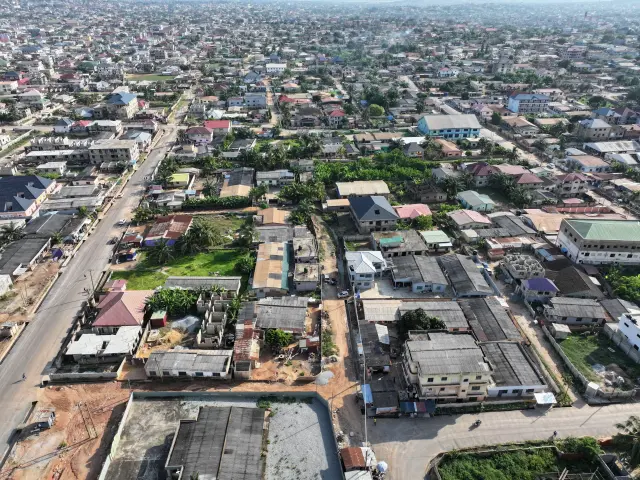
Land Acquisition and Property Rights in Ghana’s Slums: The Roadblocks to Housing Reform
Urban housing crisis in Ghana has been presented in perspective as inadequacy in the supply system, hiking of rent, and diminished access to mortgaging funds. However, behind these visible powers lies the other institutional constraint, the troublesome and sometimes controversial land tenure and property ownership systems, particularly in the informal settlements.
 Accra, Kumasi, and Tamale have populations of urban poor people
whose majority of the residents live in the slums and unplanned communities
where tenure security is low, documentation is low and claims to ownership
rights are hotly disputed.
Accra, Kumasi, and Tamale have populations of urban poor people
whose majority of the residents live in the slums and unplanned communities
where tenure security is low, documentation is low and claims to ownership
rights are hotly disputed.
These facts pose a big obstacle to useful reforms in
housing. Lack of protection of property rights makes residents unwilling to
spend on home improvements. The absence of clear titles to the land puts off
developers and financial institutions from injecting capital into redevelopment
projects. Affordable housing programs run by the government are expensive to
delay and litigate without smooth acquisition procedures.
Slums do not just appear due to poverty; they are also the result of systematic failure of land regulations. Uncertainty is brought about by customary land tenure, statutory overlaps, bureaucratic bottlenecks, and political interference.
The whole situation is further complicated by the
historical land purchases by the state, which were poorly compensated or
documented and caused bad blood and lawsuits.
This blog analyzes how the issue of land acquisition and lack of property security in the slums of Ghana is hampering housing reform. It examines how systems of land tenure changed over time, the facts of informal occupancy, and the economic impacts of unstable title rights, institutional failure, policy conflicts, and the possibilities of an inclusive reform agenda.
These structural barriers need to be dealt with in case Ghana is to open the
door to solutions to its affordable housing crisis.
History of Land tenure in Ghana
The issues of land acquisition in slums of Ghana cannot be comprehended without considering the historical land tenure systems in this country. The Ghanaian land legislation is a dual control that incorporates traditional ownership and legal statutes.
About 70-80 percent of land is
managed by customary authority, which is under the control of stools, skins,
families and traditional leaders. The other part is the vested land or
state-owned land.
Prior to the colonialists, land was mostly communal and was governed by traditional norms and controlled by chiefs on behalf of the community. Under the colonial rule, the statutory laws were established to control the land dealing, cities planning and state purchases.
But these laws
did not in most cases supersede customary practices but they were in most cases
complementary. What ensued was a mixed system that is still in existence today.
After gaining independence, the state widened its powers and
had possession of land to be used by the people through infrastructure and
houses. Nevertheless, the process of acquisition was not always followed with
sufficient compensation and corresponding documentation. In other instances,
the developed acquired lands did not match with the target development, thus
triggering conflicts between the government agencies and the customary
authorities.
These were aggravated by urbanization. As urban masses grew, the peri-urban areas under customary management became the potential areas of residential and commercial development.
Sales of the same piece on several
occasions, ambiguous borders and incomplete documentation were issues that
became prevalent. Customers often found that their pieces of land were being
contested.
The case is even more complicated in slum areas. The
existence of many informal settlements has started as temporary settlements in
unused or even disputed land. These professions evolved over time into
permanent societies. Still, inhabitants are not always provided with official
references to demonstrate the ownership or rights of long-term occupation.
The presence of customary and statutory systems is
confusing. The customary land rights are acknowledged by the Constitution, but
secure title needs to be registered under statutory law. However, this can be
cumbersome, costly and bureaucratic, which is the registration process.
This historical overlapping of systems has created an
environment of land governance which is full of fragmentation and uncertainty.
These underlying issues have to be considered and resolved to make housing
reform successful. The tenure systems lack clarity and therefore any efforts to
upgrade the slums and affordable housing would still face legal and
administrative challenges.
Insecure Tenure and Informal Settlement
Inadequate infrastructure is also one of the characteristics
of slums in Ghana, in addition to insecure tenure. The inhabitants tend to
settle on the land without having a lease agreement, registered titles or
rights which are legally recognized. In some of these areas such as Old Fadama
in Accra, settlement has been an age-long experience, but tenure security has
been weak.
Unsafe tenure will turn away investments. When households
fear eviction, they will not make housing structures better. The informal
property as a security is hardly ever received by financial institutions
reducing access to credit whether the home upgrade or small business. This
continues the phenomenon of poverty and poor living standards.
Slum landlords are able to run their operations without
being officially authorized. Informal forms of renting are prevalent whereby
they are paid in cash and not on binding contracts. These arrangements offer
flexibility, but at the cost of exposing and permitting tenants to arbitrary
rent increases or eviction.
The lack of a formal recognition makes service delivery a
problem. The utility companies might be reluctant in introducing electricity or
water lines to the unregistered settlements. These areas often fail to be
integrated in the formal plans by municipal authorities.
There is always the threat of eviction. Slum dwellers will
be forced to be displaced with little legal help when the value of the land
increases or a re-development plan arises. The legal battles that court
proceedings may take can be very uncertain and time consuming.
Meanwhile, certain inhabitants claim traditional or historical ownership of land which makes formalization even more difficult. To negotiate recognition, a balance has to be established between individual rights, the interests of the community, and the interests of the wider urban development.
Unsafe tenure is therefore one of the key obstacles to
housing reform. In the absence of the means of regularizing and safeguarding
property rights, investment in affordable housing and slum upgrading is tense
and uncertain.
Economic implications of bad property rights
Economic development is anchored on property rights. Secure
tenure will allow households to own assets, use credit and be part of formal
markets. The slums in Ghana have weak property rights that limit these
opportunities.
Financial inclusion is impaired when land is not available
as a collateral. Informal properties hold high risk in the eyes of banks and
this restricts the penetration of mortgage among low-income groups. This also
presents a challenge to the developers who need to assemble big parcels of land
to carry out large scale projects because of fragmented ownership and disputed
claim.
It also impacts the larger market of housing. The absence of
clear titles raises the cost of conducting business, fends off foreign
investors and slows down the rate of urban redevelopment. Court challenges have
the potential to delay projects to years, increasing prices and decreasing
supply.
This also affects government revenue. Informal properties
can be out of the property tax systems, making their municipal resources
smaller than they would be without informal properties. Tenure formalization
has the potential to increase the tax base and fiscal sustainability.
Formalization itself however demands investment. The
procedures of surveying, documents, and dispute resolution need administrative
resources and budget. These costs have to be balanced by the policymakers
against long-term economic benefits.
Poor property rights thus gives rise to a vicious cycle
whereby low investment will result into worse housing conditions that will in
turn reinforce informality and exclusion. This cycle must be broken in order to
have a meaningful housing reform.
Bottlenecks in the institutions and Administrative Problems
Ghana has a weakness in land governance institutions due to
lack of capacity. The local planning authorities, the Lands Commission and
customary land secretariats are usually understaffed and have outdated systems.
The registration procedures might take months and even
years. Inefficiency is caused by bureaucratic delays, unequal documentation
requirements and insufficient digitization. Corruption is also a problem that
is likely to compromise the system.
The lack of coordination between agencies contributes to
problems. The overlap of the mandates causes confusion both to the applicants
and developers. It may enhance transparency and efficiency through streamlining
the processes and the use of digital land information systems.
Housing reform is thus a pre-requisite of institutional
reform. In absence of effective and responsible land management, regularization
of slums or the proliferation of affordable housing will continue to be
limited.
Slum Redevelopment Policy Dilemmas
Redevelopment of the slums is a complicated and delicate policy issue. The major issue facing governments is whether to focus on in-situupgrading or relocation. In-situ upgrading aims at the bettering of infrastructure including roads, drainage, sanitation and electricity without displacing the people to the new societies.
Relocation, however, entails the
relocation of the inhabitants to new residential locations, sometimes due to
the occurrence of massive redevelopments, or to combat environmental hazards.
Both methods have a great social, economic, and political implication.
It is specifically hard to determine fair compensation in cases where land is undocumented or unclear in terms of ownership. Residents of most informal settlements might not have a title, but might have been living on the land over decades.
A balance should be well struck by the legal structures
and the actual social conditions of the society by ensuring that the
compensation or the resettlement packages are used with the consideration of
the occupancy history and livelihood.
It is important to protect the vulnerable populations during redevelopments. The informal workers, elderly, women, and low-income households are particularly vulnerable to displacement in absence of proper support.
Minimization of harm can be achieved through safeguards like transparent
consultation processes, gradual redevelopment, secure tenure arrangements and
livelihood restoration programs.
It is sensitive to have a balance between the interest of the people and individual rights. Although the re-development on a large scale might be an answer to a better urban planning and modern infrastructure, it may also destroy the social networks and economical structures that have been long-established.
Upgrading is less disruptive in general but can have
limitations such as space, uncertainty in land rights and legal obstacles.
Consistency of policy is important. The constant change of
strategy encourages lack of confidence and delays the process. To achieve
sustainable and inclusive redevelopment results, there should be long-term
structures combining land reform, housing finance and urban planning.
Roadways to Safe Land tenure and Housing reform
The problem of land acquisition and property rights needs to be handled in a holistic and all-embracing way. Enhancing transparency and developing social trust is necessary. Electrification of land records can save a great deal of conflict, bring in more visibility, and make registration faster.
It is also important to strengthen customary land secretariats because
they control a substantial amount of land that falls within the traditional
jurisdiction. The number of alternative dispute resolution can also be expanded
to help solve the problems more effectively, thereby decreasing the number of
courts, and increasing the pace of development.
Incremental regularization of tenures is a feasible way out. Instead of having to work out all the ownership issues, government can present transitional types of security like occupancy certificates or long-term leases.
These measures ensure that the residents are more stable and more assured to
invest in their properties, although they may not be given full legal title
just now. This slow-moving tact takes up realism and reform.
The participation of the community is very important. The residents are more legitimate and less conflicts are recorded when they are part of the mapping, documentation, and planning processes.
Local knowledge
enhances accuracy whereas inclusion builds confidence between communities and
authorities. Co-operating between the government agencies and the civil society
organizations and the actors in the private sector can also lead to
mobilization of the financial resources, technical expertise and the institutional
capacity.
Finally, land governance issues need to be resolved as a
basis of housing reform in Ghana. Protecting property rights are not technical
issues of law; they support economic empowerment, social stability and
sustainable urban development. The increased coverage of housing policies will
not be able to have a lasting effect without the reinforcement of these
foundations.
Strengthening Legal and Institutional Frameworks for Sustainable Reform
Another important but neglected aspect of land acquisition and property rights problems resolution in Ghana slums is that it requires enhancement of both law and institutions.
Policies are great by nature, but the
issue that emerges is that the success of these proposals will all depend on
the capacity, coordination, and accountability of the institutions that are to
implement such policies. Even the well-thought reforms may fail without
effective systems and clear legal support.
To begin with, there is the need to reconcile customary and statutory land laws. The two land tenure systems in Ghana which have been historically based bring about overlaps and ambiguities in land tenure systems which complicate the process of transacting land and re-development initiatives.
Better-defined roles, duties, and demarcation of roles and
responsibilities between the traditional authorities and the state
organizations can minimize conflicts and hasten the process of housing
projects.
Second, the institutional capacity should be improved by
means of training, digital infrastructure, and sufficient funding. The land
registration agencies, planning approvals, and dispute resolution agencies are
usually resource-constrained, thus slowing the processes. Transparency and
efficiency can be encouraged by investing in technology-based systems such as geographic information systems (GIS) and central land databases.
Systems of accountability are also critical. Open processes,
public documents and outside regulation may foster trust between residents,
developers, and investors. When the stakeholders have trust to the system, they
tend to engage in the formal processes as opposed to the informal arrangement.
Ghana is able to establish a secure platform of inclusive
housing reform through strengthening of legal clarity and institutional
strength. Powerful structures will not only minimize uncertainty but also
foster investment and offer security to vulnerable groups and long-term
sustainability of urban areas.
Conclusion
One of the greatest impediments to the housing reform in
Ghana is the land acquisition and property rights issues within the slums. The
presence of both customary and statutory systems, and the inefficiency of
bureaucracy as well as historical resentment, introduces an environment of
uncertainty that discourages investment and creates a history of informality.
Lack of secure tenure would mean that the residents will not
be able to easily upgrade their houses, take credit, and be fully engaged in
urban development. Developers and financial institutions are also not risky
which reduces the supply of affordable housing.
Land reform is thus not an option, but a necessity. Ghana
can prepare the groundwork to housing reform sustainability through
modernization of registration systems, institutional capacity building and
inclusive regularization.
The way forward needs political goodwill, organizational creativity and community involvement. When these factors are put in place, land rights reform will open up the ability to transform the past and have today roadblocks being used tomorrow as a basis of fair urbanization.
Also read: The Legal Challenges Behind Land Acquisition for Affordable Housing in Kenya





-bsBmIgEW58.jpg)
-5yCS4OoVBg.jpg)







LEAVE A REPLY