

What Informal Settlements Like Sodom & Gomorrah Are Complicating Ghana’s Affordable Housing Crisis
The problem of affordable housing in Ghana has become one of the most urgent issues of urban development in West Africa. As population grows and urbanization rises at an alarming rate, and access to formal housing finance remains limited, the demand for safe and affordable homes has remained far beyond supply.
 As the policymakers discuss levies, mortgage reforms, and
public-private partnerships, another fact remains on the ground: the growth of
informal settlements.
Among the most globally known ones is Sodom and Gomerraw, also referred to as Old Fadama, an informal settlement that is situated on the outskirts of Agbogbloshie in Accra. Despite its provocative naming and symbolism, the settlement has developed to embody the persistence of urban migrants as well as the failures of housing policy structure.
There are other
thriving cities in the country, such as Kumasi, Tamale, Takoradi, and others,
with similar communities. They do not exist as individual phenomena; they are
part of the urban housing machine of Ghana.
The informal settlements have many ways of complicating the affordable housing crisis. They experience housing demand, overload the existing infrastructure, generate environmental risks and create governance challenges to the authorities.
Simultaneously, they offer cheap housing to
thousands of employees who drive the economy in cities. An effort to solve the
housing shortage in Ghana without informal settlements is likely to ignore a
key aspect of the problem.
The discussion in this blog focuses on the fact that
informal settlements such as Sodom and Gomorrah are causing Ghana to fail in its
affordable housing crisis. It discusses the structural forces of informality,
the economic forces in these societies, the policy conflict between the forces
of eviction and redevelopment, infrastructure and environmental, social, and the
necessity of integrated urban reform.
The Emerging Urban Informal Settlement in Ghana.
Informal settlement development in Ghana is directly
related to urban migration patterns and economic transformation. In recent decades, urban centers (especially Accra and Kumasi) have been receiving
rural migrants who are interested in employment, education, and better living
conditions. Formal housing supply has, however, failed to match this demographic
change.
Sodom and Gomorraw became one of the settlements of low-income migrants, most of whom were migrants from the north. It was located close to markets and economic centers. In the case of people who have their daily routine work in the informal segment of the economy like scrap dealing, head portering, and petty trading, location becomes very important.
The theoretical cheapness of formal housing in the urban periphery can be offset by the
transportation expenditure.
The main cause of informality is affordability differences. Even so called so-called affordable housing projects usually serve middle-income earners as opposed to the urban poor. The high prices of land, the red tape in obtaining titles, and the increased cost of construction compel developers to resort to other segments of the market that are more lucrative. The outcome is a structural barring of low-income households to formalized housing.
The second cause is the complexity of land tenure systems.
The traditional land tenure, duplicate ownership and the slow registration
systems present hindrances to developers and individual home owners. When there
are no available secure land markets, informal occupation will be a survival
mode.
The informal settlements are thus not just illegal
encroachments but they are signs of failure in the housing system. They occupy
a gap created by poor planning and insufficient investment by the people. These
communities eventually form their own social networks, systems of governance
and economic systems.
Nevertheless, their development also creates some serious
issues of urban planning. The settlements do not have a well-structured layout,
drainage, sanitation facilities, and access roads. Constructions are done in
stages, with the materials available and without permission. Although it
enables quick growth, it makes it difficult to later regularize.
Eviction or demolishment of informal settlements has
traditionally caused outrage among population and humanitarian issues. The fact
is that residents usually have no other option of residence. When relocation
programs are made, they often fail especially because of poor site selection or the absence of livelihoods in new locations.
Economic Reality within Informal Settlement
In order to comprehend how informal settlements make housing
policy challenging, one needs to look at the inner economic dynamics of
informal settlements. Sodom and Gomorrah are not dormant poverty areas but
dynamic economic places which support thousands of livelihoods.
The inhabitants are doing various activities- scrap metal
recycling, informal manufacture, vending in the street, transport services, and
domestic work. It is close to commercial centers which is strategically
advantageous. Most of the time these workers are walking to their work place
thus cutting the cost of transport and adding to the amount of money they are
able to keep every day.
The settlements are housing structures that are usually
self-constructed using cheap materials. The rent is much lower than it is in
formal neighborhoods, but is also subject to market forces. Informal landlords
tend to subdivide small parcels into several rental units, and form
micro-economies of housing supply.
Nevertheless, there is high economic vulnerability. In the
absence of written tenancy contracts, tenants run the risk of evictions. There
is low access to credit because unofficial addresses are not legally
recognized. The insurances are practically absent and families are vulnerable
to fire outbreaks and floods.
These informal economies also make matters difficult in
terms of collection of taxes and generation of revenue in the city. Residents
have a positive influence on the larger economy but such operations are not
usually subject to official regulation. This leads to tensions between inclusion and enforcement.
Informally, the informal settlements mislead market signals as far as housing policy is concerned. The developers might not want to invest in the surrounding grounds either because they have reputational risks or are unsure whether they have the land rights.
Meanwhile, informal
housing at the lowest cost also leads to a policy paradox in that the
government does not face urgency to offer an alternative.
Stigma is another factor that is detrimental to economic
integration. Sodom and other towns such as Gomorrah are commonly represented
with bad images in the media, which perpetuate stereotypes and other forms of
marginalization. These perceptions impact on policy discussions where clearance
can be favored over upgrading.
However, the eradication of informal settlements without
offering sustainable economic activities may increase the level of poverty in
cities. Most inhabitants rely on place-based earnings. Moving to far away
locations may cut off markets and social networks destroying livelihoods.
Infrastructure Deficits and Environmental Pressures
Among the most obvious challenges in informal settlements is
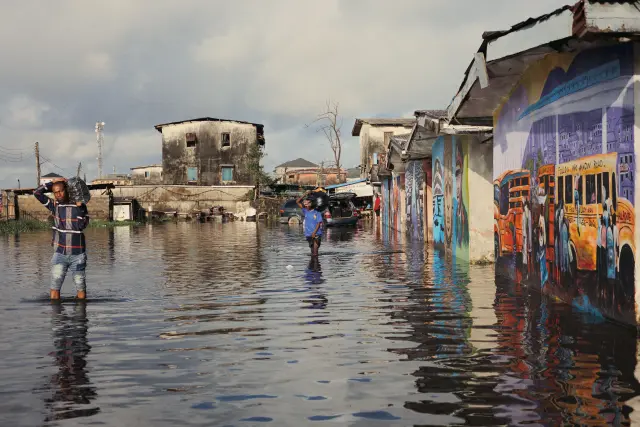
strain infrastructures. Sodom and Gomorrah has always had a reputation for being
prone to floods given that it is situated along waterways and drainage systems
in Accra. Limited waste disposal services contribute to environmental
vulnerability.
Excessive population puts strain on sanitation facilities.
There are common toilets, insufficient sewage, and poor drainage, which pose
health risks to the people. Floods may leave people homeless and propagate
waterborne illnesses during heavy rains. There are also additional hazards
associated with fire outbreaks which are fueled by a large number of wooden
structures.
Local governments have hard decisions to make. The question
of upgrading informal settlements infrastructure can be controversial
politically because the opponents claim that it grants legitimacy to illegal
occupation. However, the lack of services sustains the crises of
humanitarianism and destruction of nature.
In Ghana, urban planning has had difficulties keeping up
with informal growth. The lack of mapped layouts makes it hard to install water
lines, electricity grids, and access routes in case of emergency. Converting
infrastructure to high-density settlements is very costly when compared to
designing infrastructure.
Sustainable environment goes beyond the limits of settlement. Mismanagement of waste may impact downstream society. Contaminated waterways affect the ecosystems and city strength. Climate change adds urgency.
The increased variability of rainfall and abnormal weather patterns make
marginal land settlements susceptible. Informal settlements have been subjected
to imbalanced climate risks without sustainable infrastructure and drainage.
These infrastructure gaps need a concerted effort between
the municipal governments, the planners, and the ministries of the country.
Incremental upgrading, whereby drainage, sanitation and roads are upgraded
without mass evacuation proving it in some cases in the world.
Such initiatives are however put on hold due to funding constraints and political sensitivities. The existence of informal settlements hence makes it difficult to implement wider affordable housing planning because the funds are not being utilized in long-term planning plans but emergency reaction plans.
Policy Tensions: Eviction, regularization or integration
The governments that followed in successive Accra struggled
to know what to do in reaction to Sodom and Gomorrah. Periodically, demolition
exercises were suggested or conducted using the arguments of environmental and
security issues. These measures are hardly permanent solutions, however.
Unless there are proper resettlement strategies, evictions
may lead to social uprising and international condemnation. Other human rights
agencies call on the need to be provided with due process and alternative
places to stay. Meanwhile, the authorities claim that some places are too
dangerous, particularly those areas that are liable to flood.
Another alternative is regularization. The security of
tenure and inclusion of settlements in formal planning systems can open the
door to investment in housing upgrading. The legalization of land occupation
can however be a complicated issue especially when there are disputes over
ownership.
Integration needs political determination and vision. It
entails the modernization of infrastructure, identification of the community
associations and availability of finance. This model considers the informal
residents as stakeholders and not as barriers.
The inconsistency of the policy is a step backwards. The
political changes in leadership often lead to a change in strategy making the
situation a matter of uncertainty to both the residents and the investors.
Long-term solutions require a bi-partisan approach.
It is difficult to reconcile between environmental
protection and urban planning values, and social fairness. Demolition, which is
heavy-handed, can be used to clear the land in the short run, but as long as
there are no inexpensive viable substitutes, new informal settlements will be
created in different areas.
Therefore, the policy tensions in relation to informal
settlements cut right across the affordable housing crisis in Ghana. In the
absence of elaborate frameworks that integrate prevention, upgrading, and the
new supply, the informality cycle will continue.
Urban Inequality and Social Implications
The inequality issues are intertwined with informal
settlements. The poor access to quality education, medical services, and social
services is usually experienced by the residents. Stigmatization drives up marginalization, which strengthens poverty cycles.
However, social cohesion is also high in these communities.
Community leaders, ethnic associations and informal support networks are very
crucial in the resolution of disputes and the provision of welfare. All the
housing interventions should consider such social structures.
Spatially, inequality in the city is realized. There are
gated communities and luxury developments which are next to informal
settlements of high density. This opposition contributes to the controversy of
inclusive growth and equitable development.
The policy on affordable housing should thus not rely on
physical buildings alone but also the integration in the society. Mixed-income
developments, inclusive zoning, and participatory planning can be used to
overcome differences. Not introducing social aspects will result in increased
exclusion. Housing is not just shelter but it defines access to opportunity and
civic engagement.
Planning a Way in Inclusive City Housing
The affordable housing crisis in Ghana would not be resolved without directly addressing the informal settlement issue. They are not marginal to the problem, but they are in the middle of it. The only significant solution should include both prevention and transformation.
On the prevention front, the government will have to drastically increase the provision of affordable housing by providing specific subsidies, land reform, and new financing schemes that would allow low-income and middle-income households to afford home owning or secure rentals.
New informal settlements will keep on
increasing with the increase in urban populations without resolving the
affordability gap at its root.
Simultaneously, the current informal settlements should be modernized carefully instead of being displaced on a mass scale. Improvements in infrastructure like drainage systems, sanitation facilities, electricity, and access to roads can significantly increase living standards without moving people out of their homes.
Participatory planning can achieve livelihood
preservation through incremental improvements that will improve safety, public
health, and environmental resilience. It should be incorporated into the
official urban system and not destroyed.
Cooperation is important in achieving this balance. Good coordination between state agencies and the local governments with community-based organizations are also critical in ensuring that the policies are workable and inclusive.
Evidence-based planning may assist in determining
areas of priority and efficiently allocating funds, and transparent funding
mechanisms will help create trust in the government. Equally critical is the
long-term political commitment that goes beyond election periods, giving continuity
to the housing policies.
Finally, informal settlements are not the exception in Sodom
and Gomorrah; they are not the exception but rather the symptoms of further structural issues. They expose housing demand shortages, weak
governance, and structural social inequality. They can be tackled with
discretion and a long-term plan to not only improve the situation of their inhabitants but also to boost housing policy in Ghana and the urban development
agenda.
Conclusion
Sodom and Gomorrah are informal settlements that create a lot of complexity to the affordability problem of housing in Ghana. They are not standalone issues but are the manifestations of underlying structural predicaments, lack of housing supply, access to finance, faulty land administration machinery, and rapid urbanization.
With faster urbanization than
formal housing provision in the cities, poorer households have no other
choice but to reside in informal settlements. This is where policy loopholes
are seen in such settlements and not individual failure.
Meanwhile, informal settlements are important in the economic context. They offer cheap housing near employment and business hubs that support thousands of residents to make a living.
Nevertheless, they are
not well planned, which causes a strain on infrastructure. These are bad
drainage, congestion, low sanitation, and a lack of adequate waste disposal, which
enhance environmental and health hazards. The conditions also make planning of
the cities difficult and place a burden on the available policy frameworks.
Eviction in itself is not a long-term solution. Forced displacement, particularly when there are no viable options, is merely sweeping the issue under the carpet and usually increasing poverty. Lack of attention is also not effective since it lets the situation get worse and dangers compound.
This requires a balanced measure; however, it is a measure that incorporates
proactive actions to increase the supply of affordable housing as well as focus on
upgrading and gradual absorption of the prevailing informal communities into
the formal city structure.
Ghana is at a crossroads. The country can use structural causes of informality and adopt an inclusive urban reform that can turn its housing crisis into a chance to achieve equitable and sustainable development. The future of cities in Ghana lies in courageous action that is focused and people based.
Also read: Slum Upgrading In Nairobi: How Housing Projects Are Transforming Informal Settlements












LEAVE A REPLY