

-DhYTN0ptZf.jpg)
How Pakistan’s Rs. 5B Budget Boost could build 40 K Affordable Homes
Pakistan is at a crossroad between urbanization, social issues, and economic corruptions, yet housing affordability should not be discussed as an urban policy matter but a matter of national importance. The housing deficit that is currently above 10 million units is an infrastructure challenge as well as a humanitarian concern considering the growing population in cities and the rate of rural-urban migration. As an answer to this, the announcement by the federal government to provide Rs 5 billion allocation in its current budget promises to be an intervention.
This figure is not enormous in relation to the demand but when funded with focus and exactness and innovation, it may even propel the creation of around 40 000 more affordable houses. This critical increase in the budget is not merely a fiscal gesture but also a statement that looks at housing as a socio-economic right and as a development tool.
Money is not the only thing that can help to translate this chance into actual dwellings. It rests on political will, city governments, and innovations in construction, financial engineering, land reform and partnerships capable of bringing actual change to the greater good. Herein this blog, we discuss the dynamics of this budget allocation, the viability of this allocation and the measures that would enable Pakistan to transform this financial stimulus into an inclusive, resilient, and equitable urban housing environment that transforms the lives of 40,000 families and which sets an example to the rest of the millions.
Budgetary Potential and Cost Logic
At a first glance, Rs 5 billion housing allocation is nothing revolutionary, but the point behind such is its ability to be optimized in terms of cost, scale based design and implementation strategy. Theoretically, the government would have the capacity to construct 40,000 housing units at the target cost of Rs 125, 000 per housing unit. Nevertheless, to achieve this aim, strict management to all phases, i.e., procurement to execution is needed.
The low-cost housing in Pakistan averages Rs 500,000 to one million depending on the locality, design and material. The price of Rs 125,000 per unit can only be achieved through subsidized real-estate, government schemes as well as local methods of construction indicating mix-models based on pre-approved patterns. One of the largest cost savings can be seen in the removal of land costs to purchase that land, i.e., that cost is a large cost of development, however, should it be made available by the government (unused or public land in the peri-urban areas) then development of such is much more feasible.
Also, less bureaucracy in the building approvals, prefabricated material and modular constructions are an option to squeeze the schedules and cost. The innovation in financing partnerships is in real. The Rs 5 billion may be in the form of equity or collateral in a blended finance with multilateral banks, Islamic Housing Funds, or national microfinance suppliers.
In such a manner, the state interest is not only an inducer but also never the full financer but releases several folds of other resources. Investing this fund in housing boards that have successfully shown their capacities to deliver and have transparent processes, Pakistan would be in a position to benefit due to economies of scales, public procurement system and ready-cleared lands to make sure that this part of the budget brings rooftops under the head of real families.
Education Using the Available Affordable Homes Models
Pakistan does not have to reinvent the wheel, there are national and international examples of how this should be done. On national-level, schemes such as the Punjab Peri-Urban Housing Scheme and the subsidized apartment projects in Khyber Pakhtunk to reflect how housing can be pursued at scale by the government. Yet such bottlenecks experienced in such initiatives such like litigation of land, delays in procurement or poor community engagement should be dealt with beforehand. We have a specific reference that is very helpful to us internationally,
India. Having the same socio-economic background, PMAY applied specific subsidies and direct beneficiary identification and digital land records to construct millions of houses. Similarly, Indonesia and Ethiopia have demonstrated the way in which organized public-private relationships (PPPs) may combine governmental assistance and business efficacy. The INFONAVIT housing program in Mexico proves the potency of contributable housing systems connected with wages of employee and workers. Pakistan will use a hybrid model through its 5 billion Rs fund as it can be anchored by allowing partial upfront construction cost to be provided by the government along with guaranteeing loans mobilized by the microfinance institutions.
The most important thing is not facility construction but consolidation, land, finance, design, and participation of communities. In addition, technology has the capability of promoting transparency in procurement and beneficiary selection. Centralized online portal would check the status of a project, the payments, and, inspections to reduce the corruption rates and increase confidence.
To more rapidly process the approvals, the government ought to create prototypes that are replicable, the basic type being two room simple house that utilizes local weather and materials and present it as open-source plan to developers. Such measures that have worked elsewhere can help ensure that the planned investment in Pakistan is not a random occurrence but a play of a national plan that can be replicated in other regions to eradicate the menace of housing insecurity in a methodical manner.
Integration of land use and Urban Planning
Land is the most costly and restricting element of affordable housing. The expansion of the cities in Pakistan is irregular because of poor implementation of zoning rules, speculative prices, and the lack of unification in ownership. This housing budget can neither be operational without strategy, provision of their land being strategic, legal and sensitive to the community. The state government must target such places as a peri-urban land banks or state-owned lands because of their insensitivity to the ecology or no agricultural utility and should make specific affordable housings on fast-track development policies.
The inclusion of these in master plans of urban areas would guarantee transportation, drainage, access to schools and future habitability. Another crucial process will be the computerization of land titles in order to prevent court cases and delays in the completion of the projects. Before the launching of projects, title verification and mutation should be done using NADRA and provincial land record authorities. With land clearance, then projects can be developed through compact layouts, row housing, cluster developments, low-rise apartment blocks without sacrificing dignity as much density can be attained. It is also essential to plan mixed-use spaces.
Opening of small commercial shops or skills centre in housing schemes makes them employable and socially intact. Such cities as Faisalabad or Multan may be on the forefront of such models, since the process of urban sprawl is yet to be completed, and the available land is relatively cheap. Disaster resilience ought to be part of the urban planning, too.
As floods, earthquakes, and heat waves are on the increase, designers should adhere to safe construction regulations and architectural designs that are responsive to climatical conditions. Instead of considering housing outside of the city, these houses should be included in urban development of Pakistan. This does not only give them a safe footing but also they will not be ghettos or interim settlements, but operational blocks within a modern, pluralist urban tissue.
Technology and Speed of Construction
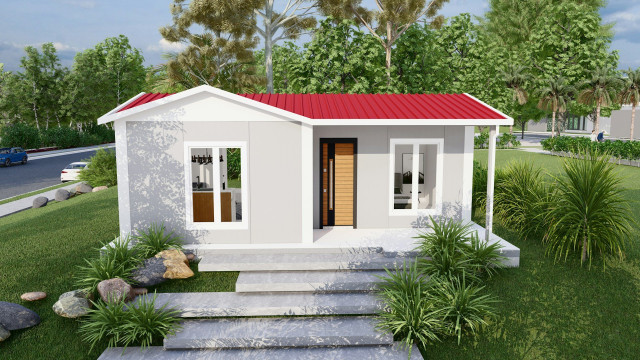
In the situation of increasing inflation and limited labour resources, we will not be able to construct 40,000 houses by using the traditional brick-and-mortar methods. Pakistan needs to resort to new technologies in construction, which are cost-efficient, low energy-demanding, and rapid. Such potential is provided by prefabricated panels, modular container units and fly-ash blocks. Although prefab construction is already applicable in schools and clinics in Pakistan, it cut the time of the construction by 50-60 percent and saves 30-40 percent costs, on average. Such approaches also make the quality standardized which is important in large houses.
They can scale up experience in modular housing by companies such as the Frontier Works Organization (FWO), NLC, and local startups in the case of public procurement. Building Information Modelling (BIM) can prevent operational errors as well as schedule and predict the cost overruns as best suited to large projects driven by the government. Besides, the homes can be more viable and sustainable in the long-term through energy conservation materials such as an insulated roof, water-efficient plumbing.
Pakistan ought to also mine its own cement and steel producer and rather ask them to sell this material at subsidised prices as a corporate social responsibility to them or offer incentives on the taxes. The procurement reform and the application of modern building methods will enable the government to curb corruption and delays and provide good housing within a shorter period. The final goal is to end the cycle of cost escalation and blockage of housing projects that has marred earlier housing projects. Provided that such a deployment of technology is sensible, such Rs 5 billion may also serve as not only financial intervention but guidance on how the country is going to be constructed in the future.
Financial Innovation and Housing Microfinance
The key to making allocation of the budget a reality is financing. The housing finance sector in Pakistan has been shallow with a current low penetration of less than 1 per cent of GDP on mortgage products. Low earning lenders are considered risky by traditional banks and loans are not always affordable because of the interest rates.
This is however changing. As the number of Islamic microfinance institutions, fintech lenders, and community-based cooperatives increases, a fresh housing finance mechanism arises. The blended finance model can be seeded using the Rs 5 billion with the government giving last mile connectivity in terms of land and partly built housing and microfinance institutions providing home loans over 10-15 years charged at below market rates to recipients.
This distributes the burden of financial resources, involves recipient empowerment and also provides a superior maintenance of the houses. This budget should be directly linked with the recent expansions of the State Bank of Pakistan in relation to offering credit lines housing and interest subsidies. Establishment of Housing Micro finance fund would make donor funding available in the form of institutions such as World Bank,
Islamic development bank and USAID. Such funds may complement the capital of the government, which will increase outreach and sustainability. In the meantime, the risks of default would drop on digital credit scoring based on biometric verification with the aid of NADRA data. The end game should be a self-sustaining ecosystem where the state can allow entry into formal housing but with utilizing financial innovation as opposed to complete subsidising. Through that, housing would be a personal property and not refuge, thus raising social mobility, employment, and tax contribution. Pakistan should transform its housing sector beginning this budget using the appropriate tools.
Community Ownership and Livelihood Integration
Affordable housing is not just going to hand out four walls and a roof, it will be making whole communities sustainable. In order to make sure that the 40,000 households projected in line with the Rs 5 billion budget will prosper, community ownership and livelihood should be included in the very core.
Placing in a home a lonely person is not the same as connecting ability to pay with education, health care, and transport, and this way, the house stock will become underutilized, run down, or even vacant. Raising the capacity of the communities by using participatory design procedures guarantees housing that reflects cultural and social needs in addition to physical needs.
The construction process can involve women-led cooperatives, the local masons, and the social entrepreneurs to provide employment and ownership to the same time. In the same regard, the connection between housing schemes and locally based employment centres-including agro-processing centers, industrial states or digital gig spots-will guarantee continuity in income. It is possible to establish community development councils to regulate the common infrastructure, cleanliness, and arbiter. These local authorities develop faith and avoid dilapidation prevalent in old housing colonies.
Moreover, one can even mix solar mini-grids, rainwater harvesting, and waste-to-compost, which will enable these communities to save on their utilities and carbon footprint. Housing clusters with schools and clinical facilities located within the same designated site allow us to consider the needs of both the residents and people living in the informal settlements and create more inclusive urban guidelines. Jobs and amenities hence become the glue that binds up a housing project. In its absence, even the well-designed of units would be turned into ghost towns.
However, through inclusive planning, these 40,000 homes can give way to livelier, more self-sufficient communities and turn out to be something different than what the affordable housing can be in the future of Pakistan.
Tracking, Policy Consistency and Political Desire
Converting Rs 5 billion into 40,000 sustainable homes will all come down to three powers, namely policy alignment, transparency, and political will. Administered transparency, lack of continuity and misplaced provincial-federal functions are the bane which has sabotaged many well-meant schemes in Pakistan. As such, any investment that is made on the budget should be supported by a performance based accountability framework.
Dashboards of improvement that display progress, cost expenditure, and methods of redress to grievances on a real-time basis will be essential in earning the confidence of the people. The initiative should further be aligned with the other policies that are currently in place, such as the National Housing Policy, the Housing for All Vision in the state of Punjab, and the urban resilience schemes under the state of Sindh. De-fragmentation has to be resolved among department, land agencies, and local government by inter-agency task forces with specific deliverables.
Their legal arsenal empowering these homes too has to be well equipped in terms of land title security to tenant rights so that the same cannot be abused or evicted after the occupation. The one is not there, however, but political will.
Budgets turnover but political commitment can turn an effort that lasts a year into a generational change. This cannot be viewed as a handout by the legislators, but rather as investment in social stability, economic growth, and climate resilience. It should be guarded throughout the election cycle. This Rs 5 billion can be a unifying act, in an otherwise divided age, when housing inequities tend to make social disparity even larger--a demonstration of how good governance can have a very real and positive impact on bringing livelihoods up and lowering vulnerability to merchant warranties and setting Pakistan on the road towards urban justice and human dignity.
Conclusion
With a mere Rs 5 billion earmarked towards housing, the potential that the allocation can bring upon the country can be immense in transformation. When done right in terms of discipline, transparency and innovation, or even by delivery of 40,000 homes, it can redefine affordable housing in Pakistan, not just by delivering homes, but by developing delivery models which are replicable, scalable and robust. Whether it is a strategic land use, prefab technology, blended finance, integration with the community, local government, and policy coherence, each step of the process must show the urgency and possibility that affordable housing offers.
Housing can no longer be considered a welfare expense, it has to be viewed as infrastructure, as a means of stability, as a platform of a working and fair society. The chance facing Pakistan is not only protecting its citizens but enlightening them economically, socially and politically. One house will alter the life course of a family, 40,000 will alter the life course of a nation. This is the time to put its actions, not slogans, into systems. The Rs 5 billion is not the limit but the basis. The housing future of the country in the next couple of decades will depend on what Pakistan can construct using it as a foundation.
Also Read: Pakistan’- A framework for affordable housing in Pakistan, 2019



-3dkuLgKhRD.jpg)
-49HupTvwDD.jpg)








LEAVE A REPLY