

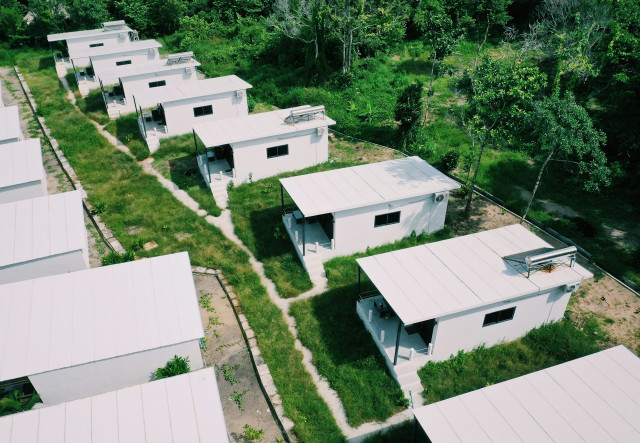
Disaster-Resistant Housing in Climate Change Adaptation
With increased effects of climate change being felt round the world, the susceptibilities of our residential and infrastructural systems are rising to the surface like never before. Floods, hurricanes, wildfires, droughts, and heatwaves are not isolated events in time, anymore, they are recurring, disruptive, events that test the resilience of communities, economies, and ecosystems.
Among the various strategies to create resilience to these changing realities, one of the biggest anchors is the design and construction of a disaster-resistant housing. Housing is not just shelter but the key to stability, dignity and security. Structurally inadequate homes also become obsolete in the event of an emergency, leaving families homeless and losing their sources of livelihoods, and as a consequence, making it more costly and time-consuming to recover. Disaster-resistant housing is therefore not just related to survival but more broadly to the long term sustainability, minimization of social inequities, and the creation of resilience in the very architecture of communities.
Disaster-resistant housing is not only beneficial due to the capably of proving immediate threats but also because of how such housing can aligned to the larger climate change adaptation objectives. Flood-resistant structures, houses that withstand natural disasters and heat, as well as fires, are an excellent way to protect the weakest groups of the population and allow them to stay afloat in adverse conditions, as well as minimize the cost of their reconstruction. Simultaneously, however, these houses can incorporate lessons of sustainability, including energy efficiency, water conservation, and materials that are environmentally friendly, and therefore are not only applicable in areas prone to disasters but any place where such ideas of adaptation and resilience are of interest.
This blog discusses the significance of disaster-resistant houses in climate change adaptation by answering the following questions: why resilience is essential; how the design and technology is developing; the role of governance and policies; the implication on social and economic aspects; and the perspective of adopting a long-term strategic approach towards creating disaster-resistant housing to ensure its inclusion in affordable and sustainable housing. It also becomes obvious that constructing the disaster resilient houses is not a choice anymore, but a necessity to survive and access to the social justice of a warming world.
The Necessity of Resilience in the Age of Climate Change
Without a doubt one of the most urgent issues of our era is the unpredictability and the occurrence of the climate-related disasters. An increase in temperatures in the world is causing an increase in the intensity of hurricanes and the climatic wobbling rainfall amounts are causing a major cause of floods in certain areas and increasing the incidence of drought in other areas. Wildfires are becoming year round, rather than just seasonal. Millions of people in vulnerable regions find that housing which is traditionally regarded as being safe is actually becoming a frailer habitat. The need of resilience in housing is due to the fact that houses are both fundamental points of security and a vulnerable target.
In the case of disasters, as the initial infrastructure to fail it is housing. The floods fill homes with water and make them inhabitable; high winds rip off the homes leaving the family out in the open; the fires leave no trace after burning down structures within minutes. In addition to the physical damage, such losses are a blow to livelihoods and cause displacement crisis that would worsen already existing social and economic inequalities. That is the reason resilience is not only an issue of design but a humanitarian requirement. So long as people lack adequate housing that can withstand the effects of climate change, adaptation measures are incomplete and people continue living under constant repetitive cycles of loss.
Resilient housing will consider the climate in the area, the geography of disasters, and also the social-economic conditions of the people living there. In coastal regions, it can require elevating housing to beyond the reach of floods or materials that cannot be damaged by water. In wild fire prone areas, it is comprised of fireproof sidings, roofing and landscaping that prevents rapid spread of fire. In areas with high earthquake disasters, their structural designs must be able to sway.
The need of resilience also goes to affordability. Relatively high-income countries or the wealthiest communities cannot afford to follow these designs; disaster-resistant housing has to be available to everyone, particularly to the most vulnerable populations to the devastating effects of climate change.
In addition, the resiliency in houses leads to a direct reduction of recovery costs. Recovery efforts after calamities eat up immense portions of money and resources that can be utilized in development. Investigations have always revealed that it is a lot cheaper to invest in resilient design at the initial stages than to get into rebuilding after a disaster.
To illustrate, it might be more economical to build up the foundations of a house against high winds when this construction is cheaper than the reconstruction of the house after it completely collapses due to the storm. The resilience need is therefore not merely in the design of safety, but also the means of financial approach regarding the high prices of standing still.
Resilient housing is also effective in increasing psychological security the realization that the home can survive a disaster helps to eliminate stress and consequently increase well-being of the family so that a family can now shift its attention to long term worries as opposed to trying to survive. The notion of home should no longer be associated with a small enclosed structure characterized by four walls and a roof because, in light of a rapidly changing climate, the whole idea should be redefined as a fortress of resilience designed with the specific goal of offering its protection to the lives and preserving communities.
Evolving Design and Technology for Disaster-Resistant Housing
Improved housing in the 21st century heavily depends on cutting-edge construction and smart technology in order to achieve homes that could be able to endure all the climate variances. In contrast to conventional types of housing that did not emphasize much on either aesthetics or functionality, new housing models focus on flexibility and stability in times of disasters. Such has been the importance of one of the most recent developments in the field the invention of new types of materials with a combination of strength, sustainability and economics.
An example is the concrete that is reinforced with fiber composites and this has enhanced resistance to earthquakes as well as being lighter than concrete. Likewise, fire retardant insulation commonly referred to roofing materials, e.g., metal or clay tiles, are being applied more in wildfire prone areas. In flood-prone regions waterproof sealants, raised foundations on houses and floating architectural designs make the houses resistant to being inundated. Though initially considered experimental, those technologies are slowly making their way into the mainstream as climate disasters necessitate building innovation.
Disaster-resistant housing also depends grossly on modular construction. A prefabricated module can be constructed away and through controlled environments and this is a guarantee to better quality and uniform safety standards. Since they can be pre-fabricated, these modules are usually combined in a location- to make them very practical in recovery situations brought about by a disaster. In addition, modular structures can be customized to suit environmental risks, whether this is by raising them higher than flood levels, seismic bracing in the case of earthquakes or even the installation of solar energy panels to provide autonomy in cases of lengthy outages.
Another potential technology that can be used in insuring disasters is smart home technology. Smart Homes with smart sensors can detect weak points in buildings, monitor water levels in an area facing a flood, make predictions ahead of dangers like fire outbreak or gas leak. Such systems, when applied through low-income housing, allow residents to make decisions using updated information so that a disaster does not worsen. Passive cooling and heating designs also increase a home in the ability to rely less on external sources of energy during power outages in the face of severe weather.
Another significant innovation is using the local, native building techniques which proved to be durable over many centuries. Most communities in most regions have over the ages, developed housing that is attuned to local weather patterns and even local disasters. Such structures as traditional stilt houses in SE Asia are naturally flood resistant, earthen structures in dry lands are self-regulating in terms of warmth/coolness. Integrating such conventional practices with engineering produces hybrid housing forms that are contextual and climate responsive.
Finally, luxury is not the point of the development of the design and technology of the disaster-resistant housing. It is an activity that entails the combination of science, engineering, and culture knowledge in an attempt to develop houses that can resist a dynamic climate. The difficulty, however, is not just at the stage of creating these but to scale them up and bring them to all communities particularly those that are less statutorily endowed.

Governance and Policy in Supporting Disaster-Resistant Housing
The check that the policy and governance play in the promotion of disaster resistant housing cannot be exaggerated. Governments and institutions play a critical role because it is through establishing regulatory frameworks, and methods of funding and implementing such strategies that resilient housing becomes the norm or merely a vision. At the center of this initiative is the existence of building codes. The creation of strong building codes that are based on local risks associated with climate are necessary to make new housing disaster resistant. Enforcement is also significant, since lax enforcement usually leads to shoddy construction which places communities at risk.
Disaster-resistant construction policies that create incentives are also important. As an example, homeowner-based tax credits, low-interest loans, or grants, to those homeowners who have their homes retrofitted using resilient features, can drive large scale uptake. Disaster-resistant houses can also be subsidized by governments on low-income families to make sure that resilience is not restricted to higher income consumers. Insurance policies that conform to resilience standards can add further strength to this. Insurance companies can provide cheaper disaster insurance premiums to houses built in a disaster resistant kind of a way, hence providing a financial incentive in such housing.
International cooperation and aid is imperative as well particularly in the developing nations that are weak on resources. Such an adaptation policy is climate adaptation funds, development bank loans and the technical assistance to aid governments incorporate disaster resistance into national housing policies. Nevertheless, obstacles exist and there is still the problem of political will, corruption and the need to balance long and short-term economic growth with the resilience.
In spite of such difficulties, there are successful models of good governance. Other countries, such as Japan, have set very strict earthquake-resistance building codes which minimize losses when such a disaster occurs. In a similar token, the approach to resistant housing and infrastructure in the Netherlands has now become a worldwide example of adaptation. Governance is not just a function of legislation but leadership, which would entail appreciating the existential threat of climatic change and make resources available to construct homes that would protect the present and future generations.
Social and Economic Implication of Disaster-Safe Residential Building
The effects of disaster-resistant housing go beyond safety; the effects are very social and economically significant. On social level, such housing lowers scheme displacement as well as encourages stability in communities. Families that are able to stay in their homes, following disaster are those that are less likely to be affected by traumas, loss of jobs and disruption of schooling. Stable housing also consolidate the bond on the community, as the group of people is less likely to be torn apart by the disasters.
The economic gains are also overwhelming. Housing resilience saves the colossal expenditure of disaster recovery, on the part of the government and individuals. Each dollar used in building to be disaster resistant saves several dollars used in reconstruction after the disaster. The cost of resilience is thereby affordable, making resilience a good economic as well as moral strategy.
Disaster-resistant housing can, also, diminish inequality. Vulnerable populations tend to be the most vulnerable, bearing the brunt of the effects of climate disasters as it is more prone to living in more vulnerable accommodations as well as lacking the means of recovery. Policymakers should give resilience affordable housing programs first priority to ensure that low-income families do not bear a significant share of the burden. In that manner, the housing resilience will be utilized as the driver of social justice.
Integrating Disaster Resistance into Affordable and Sustainable Housing
Admittedly, the process of the incorporation of disaster resistance into affordable, sustainable housing might become the most difficult. Although resilience is critical, it has to be affordable. Otherwise, the most vulnerable generations can be considered poor households, who are still not protected. Fortunately, this can be solved by many strategies.
Disaster-resistant features may be included in any affordable housing development as a by-product of smart design and selection of building materials. As another example, the local and cost-effective and durable material may reduce the building cost and increase its resilience. Constructing energy-efficient homes with the limited space also lowers cost of construction as well as operating costs. Also, mass production and modular construction, as well as community-led housing projects can increase resilient housing scale as a cost-reducing measure.
Second, sustainability and resilience are not opposing objectives that compete with one another, but complementary objectives. Disaster resistant housing can be built to conserve energy, incorporate renewable energy and save water. This will guarantee safety of homes against disasters as well as make them environmentally sustainable and cost-effective in the long run.
Third, it must be engaged with community. The local people should be integrated into the creation and construction of resilient housing to create a feeling of ownership since engaging the local people in the design process and how to create resilient housing reflects on their practices and needs. Communities who have engaged actively in resilience developing have higher chances of keeping and continuing with these activities even beyond a long period.
Lastly, collaborations among governments, developers of the industry, nonprofits, and international organs can pool the required assets to be able to implement it at large. The unification of technical expertise, financial resources, and community effort will enable an elevated volume of technical disasters that will then become the norm more than the exception.
Conclusion
As the climate change continues to happen, homes that can withstand disasters are no longer optional, but a necessity. The resilience of our societies and the security of our homes is a consequence of how resilient our homes have been, as disasters occur more often and more intensely. With innovative designs, the implementation of new technologies, favorable governing, and inclusive social policies, disaster-resistant housing proves to be one of the most applicable, and useful methods in climate adaptation.
However, in addition to physical protection, these houses should offer you stability, equity and long-term sustainability. They protect vulnerable groups, lower the costs at which one recovers, and boost economies. As resilience is combined with affordability and sustainability, societies can guarantee that housing shall not be a building block of vulnerability, but a source of resiliency.
Future housing should be constructed on resilience. As our climate issues build, the houses that we construct now will define the resilience that communities will have in the face of future disasters. The idea of disaster-resistant housing, is, after all, an investment in the common futures of humankind-that adaptation and justice would work together.
Also Read: Urbanization and Climate Change: The Link











LEAVE A REPLY