

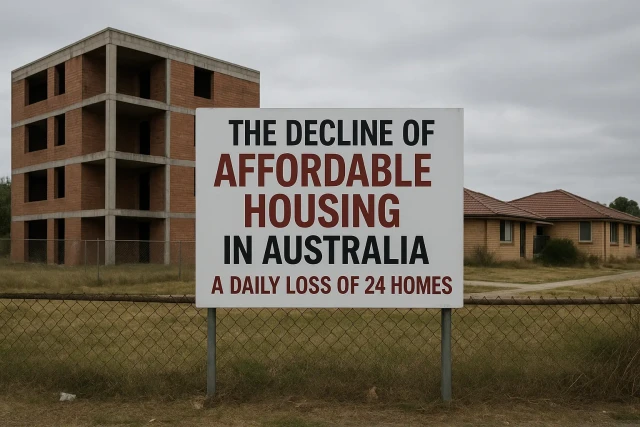
The Decline of Affordable Housing in Australia: A Daily Loss of 24 Homes
Australia is in a crisis in regards to housing greater than it has experienced in a long time. Affordable homes are still disappearing, at the rate of about 24 a day; they are either disappearing because of increased rents, the expiry of price-controlled contracts, being demolished, remodeled as high-end housing, or being bought up by investors.
The prospect of a secure, good-value accommodation once believed to be a minimum requirement of the Australian life has turned into a fairytale to thousands. Young families are challenged to find property that they can afford on rent, middle earners are feeling the pressure of mortgage and older Australians are seeing their retirement savings being gobbled away by their housing bills. This is not a crisis confined to Sydney or Melbourne, it has sneaked right across the country and left those in regional towns and cities just as worried.
The gradual loss of affordable housing in Australia is not a mere statistic, the vanishing of low-income housing in Australia is a progression of actual and hurtful human happenings. Each day when an affordable house is lost, it means the lease someone has been living within their affordable house was not renewed, the family was forced into homelessness or a group of individuals must live in smaller and overcrowded accommodations.

Behind each figure, there is a transformation in the life of an individual creating a stressful and destabilizing transformation. This blog will seek to delve a lot further than the numbers. It is more focused on the nature of this day-to-day attrition of affordable housing as reality is in fact playing out daily in Australian cities and towns, the motivation behind this tendency, and the potential social outcome of it left out of control.
Surfacing the roots and starting with the increased rent and decreased public housing to the investor-oriented market and policy failures we start to get a clue that the issue of housing crisis is not primarily that of the construction process, but of people and the future of the Australian society. The depreciation of affordable housing produces immense and extended community wellbeing, social mobility, and equality effects. To be able to find meaningful answers to the issues we must understand these impacts and reconsider the value of housing as necessity on humanity instead of a commodity.
Australian Housing is becoming a Privilege, Not a Right
Access to affordable and safe shelters has always been part of the bedrock of solid societies. But in Australia, that premise is cracking. The idea of housing has been commodified as an investor wealth generator as opposed to a human need. This menace did not occur today. In the present 20 years, the housing has evolved into a shop, which people occupy instead of a commodity that people speculate on. Property prices have escalated to levels where even people working in good jobs have a hard time to afford their first house.
Affordable rent accommodation is becoming out of reach and there is a higher demand on properties listed. Agents of real estate continuously get tens of applications per listing. Rents are increasing to the point that they make it unaffordable to live in certain areas to essential workers such as nurses, teachers and hospitality. Communities are priced out of locations close to schools, jobs and their support network in pursuit of lower rents, even these are becoming saturated.
When our quote says, 24 homes per day, what that means is those homes that were once affordable to the low or average income earning families, are now out of reach. Perhaps the rents have doubled or the lease terminated and the place turned into luxury apartments or the affordable status agreement has come to end. Whenever that occurs, it strains the system. It endangers more families with the possibility of becoming homeless.
The level of home ownership by the youthful adults continues to drop. The cheap housing and house price rises contributed to one generation with cheap housing and the other with no beginning to enter the property ladder. The switch makes housing a boundary maker not only of rich and poor but older secure owners and younger generations without foundations. Inequality is aggravated when housing becomes a privilege. It taxes the mind, decreases work output and undermines the notion of a fair go society, where the opportunity is available to everybody in Australia.
The Disappearance of Social and Public Housing
A major depreciation in social housing is one of the most disturbing factors in the housing crisis in Australia. Large quantities of public housing to accommodate people with low incomes were constructed by the councils and governments decades ago. Such systems are downsized or ignored nowadays. Repairs are stacked or many years wait is seen on the waiting lists and some of the old estates have been sold to the individual developers.
In much of the country, deteriorated low-income housing blocks are torn down and the property resold, with little to nothing affordable housing putting back in its place. The bottom line? Less and less affordable houses are being offered annually. In some instances, even inner-city land that is being used as public housing is interpreted as an untapped resource - to be sold to make a profit - displacing the vulnerable to outer surrounds or a homeless state.
It has increased this failure to invest in the public with the expiration of former affordability deals. There were time limits on some of the lower-rented houses constructed by the previous government schemes. Apartment owners could hike the rent up, or sell, after those contracts ran out, immediately shooting that property out of the affordable bracket.
The lack of funding on new social housing developments is limited, which in addition cuts us short rather than benefiting us. This is among the fundamental reasons that there is a net loss of 24 homes that could have previously been a possibility. There are governments that are talking about housing strategies but what is happening is very few that are actually realizing building builds on the scale that is needed. This gap is not being met in the private sector, since there is not much profit incentive to construct affordable rental apartments when the developers find luxury apartments to be more profitable.
Human ultimately bears the consequences with children born into an uncertain living environment, elderly renters being evicted due to price increases in the market and no housing rentals at affordable rates and victims of domestic violence being unable to vacate their abuser because of the lack of rental houses at reasonable prices. Public housing was a shield to many at-risk Australian citizens but that shield is getting smaller. The poor availability of affordable housing will only increase day by day, unless substantial refinancing efforts are made to social housing.
The Role of the Private Market and Rental Inflation
Australia represents one of the predominant trends in the present day housing scenario through the existence of the private rental market. The landlords, investors, and property management companies take their decisions on the rates of returns, rather than community need. Although there are landlords who are fair to the tenants, the system as a whole is profit motivated. As the interest rates increase, mortgages become costly and hence landlords tend to increase the prices charged to the tenants as a way of recouping the increase in cost.
The result of that rental pass-through displaces affordability of most homes. Other investors also abandon properties hoping to get better yields a process termed as ghost housing leading to a decrease in supply. While short-term rental services like Airbnb have seen most homeowners turn their long-term rentals into holiday homes, particularly in the seaside-towns. Every house that transfers to Airbnb instead of long term renting this way is one less affordable lace available to a native of your local area. This has immensely affected such places as Byron Bay, Hobart, Gold Coast and some parts of Melbourne and Sydney.
This is yet another cause, speculative buying: there are rich investors who purchase two or more properties not to use it as a rent to others, but to keep it and re-sell it to them later when there is an increase in the value of the property. These are houses that lie idle or being poorly used when people around are in need of housing. Ramped-up mortgage rates paired with the idea of letting to make profit and improperly controlled holiday rentals leave even small suburban houses unaffordable. Rental pressure experienced in the nation is strongest among low income earners but middle income employees are currently also finding it difficult.
The loss of 24 affordable homes a day is 24 opportunities lost and the private market (absent greater regulation) is not going to voluntarily create and maintain affordability. Rental limits are few and political hot potatoes, so the rents continue to shoot up. More than 40 percent of the earnings of people are eaten up in housing and some have little left to spend on food, medicine or education. The free market is effective in creating wealth too few people, however, it fails in the effort to ensure everyone has a secure abode to dwell. According to the current trends, each day more families are getting priced out unless there are changes to policy.
The Social Consequences of Losing 24 Homes per Day
There are real stories of disruption masquerading behind the numbers. When a family loses their cheap rent or cannot afford to pay nor cope up with the rising costs they might be forced to shift far distances, disrupting the schooling of children and employment of parents. Couples end up in broken relationships, their mental health degenerates and societies become disintegrated.
Such imperfects occur when teachers, nurses, care workers, police officers and hospitality workers are not able to afford housing in the area where they work. They will travel at longer distances or end up quitting their jobs or the areas, altogether. The accelerated costs of housing make individuals crowd into inappropriate directions of living. Several families run into one apartment, or one sleeps in garages and even vehicles. There are packed shelters and services dealing with homelessness are overextended.
The loss of 24 affordable homes a day does not represent an abstract number but the harassment of a person out of his home, the person going without food to cover rent, the person living in the street. It may cause more frequent visits to the hospital as a consequence of ill health, rise of stress-related illnesses, and poor educational performance in children with high rates of migration.
The long odds stacked against renting are near impossible to overcome by vulnerable groups’ women escaping violence, people living with disability, newly-arrived migrants. The pressure goes down and if it cannot find its way to go, it is pushed back through the bottom of the market and this influences the society as a whole. Neighborhoods that once might have been safe havens to a family are no longer so anymore and are full of fear and doubt.
On a bigger scale, cities are made unequal. Rich family income concentrates in inner, well-serviced spaces and the hashi has been pushed out further to geographically segregate people on the basis of income. This violates social trust and equality of opportunity. The implications are long-term and extend past housing to productivity and healthcare expenditures, as well as our conception of the sort of nation we should be. The injuries, which arose as a result of the lack of stable housing, are not easily healed. They influence the generations.
Can We Reverse the Trend? A Nation at a Crossroad
However, as demoralizing as the statistics are, there are some potential avenues of future action in the face of the statistics. It will take a national push, through ambitious policymaking, and serious, nationwide investment, to turn the tide on the crisis of affordable housing loss. The first possibility is that the governments could construct new pavements and community dwellings in vast greater quantities.
In place of hundreds of per year, we must have tens of thousands in production in the next ten years. Non-profit housing associations models have the potential to use extra funding to increase capacity without sacrificing control of rent. Such measures like the inclusionary zoning policy where the developers are compelled to reserve some part of the new developments to affordable housing can also be applicable, as long as they are applied appropriately.
Taxation policies which tie to the favour of investors and those who own more than one property might require reform. Reversal of incentives such as negative gearing, or making tax breaks conditional on the affordable renting of properties, might change behaviour. Tightening short term rental in the regions of housing shortage would free up additional housing on the long market. Rent caps or rent control measures may help tame runaway prices and provide more security to tenants, but they are still controversial. Tenant at risk support services, rent assistance and eviction protection measures might prevent the loss of home to many tenants to begin with.
Nevertheless, all these can be done with political boldness and the endorsement of the citizens. Australians should learn to choose between the concept of housing as a human right and only a profitable investment. The 24 lost houses of affordable housing being lost a day is a cry. Unless something is done, that figure could increase.
But when the country can put its housing first in the priority list of priorities and afford it the status of essential infrastructure and not a speculative investment then the downward trend can be reversed. A decision looms: either keep walking on a path of growing inequality, or restructure a system that will ensure that everyone will get an equal opportunity to safe housekeeping.
Conclusion
In Australia the loss of affordable housing partly marked by the shocking figure of 24 houses being lost per day is not just a housing issue. It is a national phenomenon that unobtrusively sapped the principles of equitability, neighborhood, and prospective. Each day that goes by without action is another day pushing more families further into instability, more children are growing up with no guarantee of a home, and another day hardworking Australians are becoming unable to afford the areas they work in.
A land where an ordinary working family could dream of owning its home is transformed into a nation in which shelter is becoming an item that can only be enjoyed by the lucky few. The fact that housing affordable housing is lost every single day is a statistic that should leave people concerned because it talks about the priorities of the society.
It does not need to remain like that. By rebuilding the housing stock in earnest, overhauling renting policies, improving the control of investor incentives, and a reorientation of the cultural appreciation of housing as a social good, Australia can arrest, and ultimately turn around the slump. The need is obvious. Each day that we don, is 24 days of lost chances. The moment has come to take action, as long as there is a hope of reestablishing a more equal housing future to all the Australians.





-3dkuLgKhRD.jpg)
-49HupTvwDD.jpg)








LEAVE A REPLY