

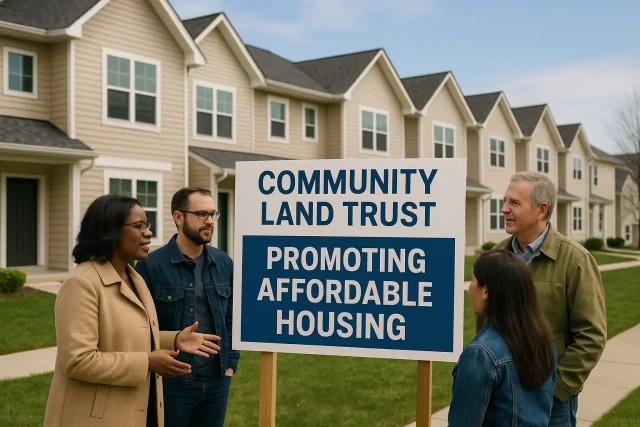
The Role of Community Land Trusts in Promoting Affordable Housing
With the price of houses constantly rising in most cities and even in rural societies all over the globe, governments and other citizens are in the quest to find long-term measures of housing that would ensure that it remains affordable. A model that is once again being considered is the Community Land Trust or CLT. Founded during the You Downloaded civil rights movement of the 1960s, CLTs are non-profit organizations which purchase land and keep it in trust in the name of the community.

They sell or lease houses on that land at a subsidized rate so that it is affordable not only to the existing and people in the community but also to those in the future. CLTs sever the price relationships between housing and land inflation by eliminating land itself as a vehicle of speculation in the market, providing a rare affordability instrumentation.
The Community Land Trusts (CLTs) models have once again become a potent and viable tool of solving the current housing crisis. The blog considers the mechanism of CLTs which is to decouple the ownership of land and the ownership of homes in order to provide residents with homes owning at a lower price leaving the same affordability not to be lost to future generations. We examine the factors that are causing this model to become relevant once again and particularly looking at a time when gentrification, escalating rents and speculative property markets have become our reality.
In contrast to temporary subsidies, CLTs establish long-term housing security through permanently withdrawing land by taking it off of the speculative market and out of private ownership and placing it under community management. They enable residents to accumulate equity because of joint ownership and have long-run benefits of maintaining the affordability of housing, hence asset accumulation of the residents as well as maintaining the wealth of a local group. This blog answers that question by looking at the fundamental mechanics, advantages, and system-wide social implications of CLTs to explain why they are becoming increasingly important in the efforts toward affordable housing that is simultaneously equitable and sustainable and community-owned.
How Community Land Trusts Work: Separating Land from the Market
The basic notion behind Community Land Trust model is a very simple and the most effective one meaning that land is not a commodity to be speculated on, not to mention that it is a source of shelter. A common CLT buys land, gets it in grants or is given through donations. This is land no longer subject to the speculative property market but under the control of the CLT in perpetuity.
The development of homes in this land can be sold or leased at affordable prices to individuals and families since the land cost does not form any part of the deal. When a homeowner chooses to sell, he/she signs up to the resale formula which limits the profit that they receive. This assures that the home is affordable to the subsequent buyer yet it enables the seller to gain some capital.
Such construction is a drastic change in the traditional model of ownership where land and home are a unit. When the market is in short supply of houses land values escalate and home prices are driven up as well. CLTs act as a mediator in owning the land as a community but leasing the buildings to them. The arrangement is legally assured by a long term ground lease usually of 99 years that details the use of the property, shares out the resale values and the right and liabilities of the resident and the trust.
Governance of CLTS is one more important factor. In contrast to either the traditional landlord-tenant relationship or a municipal housing authority, most CLTs have a board consisting of three components, including inhabitors of the CLT houses, members of the surrounding population, and representatives of the public interest or technical experts. Such a three-tier organization guarantees that the interests of local inhabitants, the surrounding community, and professional best practice are addressed in terms of decisions made. By doing this, CLTs do not simply offer housing at affordable levels, but also offer participatory democracy and as well as a feeling of collective custodianship to the local land resources.
Long-Term Affordability and Protection from Displacement
The possibility to ensure the long-term affordability is one of the most powerful benefits of Community Land Trusts. The conventional affordable housing projects are usually dependent on the cheap housing funds or tax benefit that ends at a fixed term of years. After the affordability period lapses landlords can increase the rent to market prices or even sell the house at profit, which results in loss of affordable units. CLTs never suffer this difficulty, since the land is permanently but not necessarily sold, and the restriction against resale exists as long as generations. This permanence takes care that communities are not only temporarily put at rest but its communities that have been forever guarded against influences of displacement.
Housing displacement is particularly severe in gentrifying areas. With new funds coming in, the old residents, who also belong to low-income families and communities of color, these former residents are squeezed out of communities in which they have long been residents. Ideally, CLTs are used to protect against market pressures because they preserve low prices before gentrification speeds up. They have the ability to maintain the cultural and social connections among the communities enabling residents to remain in communities and enjoy the progress of the locals instead of being displaced by their moves.
Even the long term nature of CLTs adds to the feeling of security of residents. Through the knowledge that they cannot be pushed out on the basis of rent increase or economic changes in the market,, families are able to invest in their homes and neighborhoods. Children stay at same schools, neighbors develop long-term relationships and local economies have sustainable populations. This stability is not only about finance; it is about psychological and social stability and generates a base of healthier and stronger communities.
How CLTs create modest wealth among residents through shared equity is COVID-19 related. Although there are limits on resale prices, owners at least earn some equity, so that they can develop financial security without compromising the affordability to those who follow them. A balance is achieved in this model between person asset building and community responsibility so that housing is a route out of instability to many people not merely to the fortunate who were in the first queue.
Community Control and Democratic Governance
Community Land Trusts are not a housing model as such: They are community power. Resident ownership of governing board is large in many CLTs. It implies that they get actual control on the way land is utilized, who qualifies and how to implement the policies. During a time when so many residents can feel disempowered in the face of large developers or absentee landlords, CLTs empower residents to have real control over their own communities.
CLTs are also democratic which encourages accountability and transparency. Since the people and the community have direct input in the governance, decisions are taken locally and not in the cabinets. This would help avoid some of the mismanagement, or neglect within centralized systems of public housing that do at times take place. When residents are able to influence the manner in which their houses are administered they become much more interested in ensuring that the same is maintained and improved, a process that results in improved outcomes both in terms of tenants, and in terms of the physical premises in question.
Community control does not end in housing. Other CLT initiatives, including the development of community gardens, local businesses or cultural spaces, are often the focus of wider neighborhood development. Since community controls the land, it is possible to utilize it in a manner responsive to community needs and priorities--rather than merely market profitability. CLTs in certain instances have been employed to collaborate with local schools, health facilities and social service agencies to provide comprehensive systems of support to residents. It is this comprehensive strategy that makes housing a source of community health and social solidarity.
Also, collective land management promotes civic life. The involvement of residents in the CLT makes them learn about governance, finance, and planning, develops the skills with which the residents can utilize in other spheres of civic life. This is an educational aspect that enhances democratic involvement and leadership in marginalized society. The more residents participate in the decision-making process, the more the CLT is a demonstration of citizen control as opposed to the presumption that key decisions, such as complex planning in an urban environment, require an expert, or a faceless official.
Challenges, Misconceptions, and Limitations of the CLT Model
Even though Community Land Trusts present an attractive model of long-term affordability, it is not immune to difficulties. The next most popular misunderstanding is that CLTs are identical to public housing or conventional subsidized housing. In practice, CLTs demand a special blend of finance, land acquisition, legal knowledge, and grassroots mobilisation- all of which may be complicated to line up. One of the greatest barriers is acquiring land in the urban setting where the land already costs a lot. CLTs need to develop capability to develop, manage and maintain properties even in cases where local governments give the land away or subsidize the development.
There is the long-term problem of access to funding. The fact that CLTs limit the price of a resale results in lesser financial profit to the private lenders, and it will be more difficult to access the conventional loan. The non-profit developers with respect to the CLT enterprises are usually prone to grants, donations and government initiatives which prove unstable or politically influenced. On one hand, the CLT model is financially viable over the long term; on the other end, Copland noted: it may need hefty start-up costs and close ties to local governments or nonprofits.
There exist also the legal complexities. The construction of the ground leases, calculation of the resale formulas, and adherence to the corresponding housing regulations are the tasks that entail substantial legal skills. A smaller number organizations in a community can find it hard to negotiate these legal structures without expert assistance. Also, CLT boards may become vulnerable to capacity problems due to the lack of resources and proper training. Active engagement, conflict resolution systems, and financial skills set management skills, which are characteristic of effective governance. With CLTs growing in size, NASC has to find a way of maintaining community control over quality as well as maintain professionalism.
Nevertheless, most of these constraints can be addressed with the help of policies and capacity development. Local governments are willing to provide donated land, expedited zoning approvals and other stable sources of funds. Technical support with the support of national and regional CLT networks, the new CLTs can be offered the best practices and resources. Although the model is not a short-term solution in eliminating housing crises, it is among the only means of delivering everlasting affordability without relying on constant subsidies. The awareness about these shortcomings should not be used to reject the CLT model but urge the provision of institutional strength to aid the model.
The recent Achievement of CLTs in the present day Housing Policy
Community Land Trusts have become the subject of increased interest over the last few years, especially in areas where there is high housing need and gentrification. Depreciation of CLTs is among the recent sensible policy steps by policymakers that view the tool as an essential part of an overall affordable housing policy. A number of cities have introduced large-scale CLT programs and they are usually in collaboration with philanthropic organizations or housing agencies. This new interest is indicative of a paradigm shift in how CLTs are considered, insofar as they have moved to being acceptable, replicable forms of community-led housing.
Among the factors that have contributed to this rebirth are the increased dissatisfaction by the demand with market-based solutions that are not delivering affordability. Conventional low income housing policy has traditionally depended on tax credits or vouchers that are ineffective in capping long-run expenditures or in deterring displacement. Conversely, CLTs provide a way out in terms of a structural approach as it ensures that the land is a social asset permanently. Governments are beginning to build CLTs as a means to prevent future housing crises, as opposed to responding to existing deficits.
Also, CLTs fit the modern debate regarding racial and economic fairness. A large number of CLTs were created in black and marginalized neighborhoods and serve those that have been overrepresented in housing discrimination and displacement. Together with the distribution of power and resources in a racially equitable manner, CLTs redistribute them and give communities a collective control of land. With the recent appeals to more locally focused solutions in the form of social movements, CLTs are emerging as a compelling avenue through which the labor of housing policy can align with the ideals of justice and self-determination.
Policies and the technological innovation are also assisting in scaling CLTs. Some new financing approaches like community investment funds and social impact bonds are being modified to help build community owned land projects. Legislation by local governments to prioritize land transfers to CLTs or set aside funding to develop CLTs are already taking place. In some cities, the integration of CLTs into comprehensive housing plans is even taking place, with cities acknowledging that housing tools alone are not the answer to the crisis- though CLTs need to be the solution.
Conclusion
Community Land Trusts symbolize one of the most attractive strategies towards realising permanently affordable housing, especially during the period of ever-increasing inequality and massive gentrification. With the decoupling of land and market speculation, and the incorporation of democratic governance into housing policy, CLTs provide both stability and democratization to communities who have over the years been marginalized in the housing system. Not only do they offer shelter, but also offer a means towards neighborhood and citizen wealth, participation and permanent inhabitation of neighborhoods that would be otherwise out of reach.
Although the model has some real challenges which might include issues on funding, the complexity of the legal side on the one hand, and land acquisition on the other hand, these challenges can be surmountable. The increased interest, and the emerging policy has shown that these are indeed achievable. CLTs have an opportunity to grow in a sustainable manner with the appropriate support of public institutions, including privately funded investors as well as local residents and maintain affordability of housing through the generations.
Community Land Trusts emerge in the search by governments and advocates of transformative solutions to the housing crisis not as an option but as an essential, community-centered approach that gives integrity to the nexus between economic justice and housing policy. In an era when housing as a commodity is more than ever at risk of becoming weaker and weaker, CLTs are there to remind us of something fundamental: Housing can and should be a matter of home, of place, of people and of solidarity.





-3dkuLgKhRD.jpg)
-49HupTvwDD.jpg)





LEAVE A REPLY